A 200-Million-Light-Year Gap in the Universe
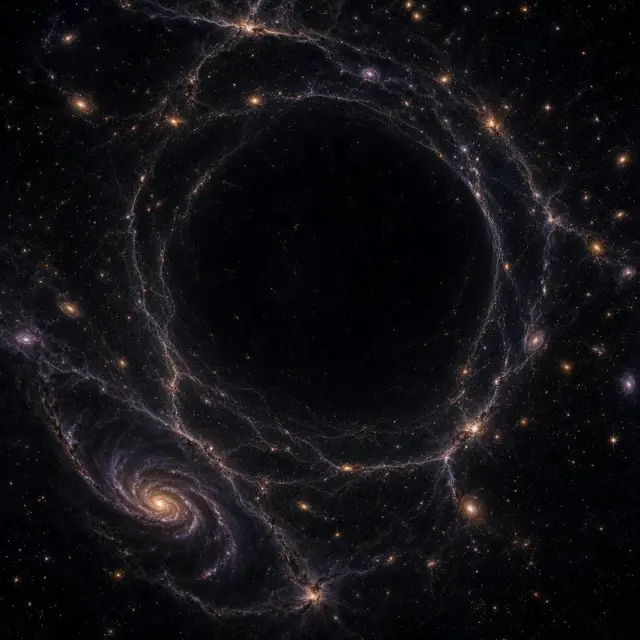
Picture flying through space for 200 million light-years and finding almost nothing along the way. That is the reality inside the Boötes Void, a roughly spherical bubble of near-empty space with a radius of 62 megaparsecs, or close to 200 million light-years across. It sits in the direction of the constellation Boötes, its center roughly 700 million light-years from Earth.
Astronomers expected a region this size to hold about 2,000 galaxies, based on how galaxies are normally spread through the universe. Instead, surveys found only 60. That is less than three percent of what the numbers predicted, which is exactly why researchers nicknamed it the Great Nothing.
Even among cosmic voids, that ratio is extreme. Most empty patches of space still hold a reasonable share of galaxies; this one barely holds any at all, making it one of the largest known voids in the visible universe.
Stumbled Onto While Mapping the Sky
The void was not something anyone went looking for. In 1981, astronomer Robert Kirshner stumbled onto it almost by accident while running a redshift survey, a project meant to map how galaxies are arranged across the universe on the largest scales.
As Kirshner and his team measured galaxy after galaxy in that patch of sky, the data kept coming back empty. Where earlier surveys had found bustling clusters, this region near Boötes returned nothing, pointed at right ascension 14h 50m and declination 46 degrees.
One small detail trips people up: Boötes is pronounced boh-OH-teez, in three syllables, not like footwear. The two dots over the second "o" tell readers to pronounce it separately from the first, a leftover from the constellation's ancient Greek name.
Sixty Galaxies Lined Up in the Dark
The 60 galaxies that do exist inside the void are not scattered randomly. They trace out a rough cylindrical shape running through the middle of the region, rather than clumping evenly throughout the sphere.
Just outside the void's edge sit the Hercules Superclusters, dense chains of galaxy clusters that mark where the emptiness ends and more typical cosmic structure resumes. The contrast is stark: on one side, almost nothing; on the other, some of the richest galaxy groupings known.
That boundary makes the Boötes Void a useful laboratory for astronomers. It shows just how uneven the distribution of matter in the universe can get, all within a single connected region of sky.
How Do You Build a Hole This Big?
How does a hole this big form in the first place? The leading explanation is surprisingly simple: smaller voids gradually merged together over billions of years, coalescing into one giant empty region.
That merger process may also explain why the void's few galaxies line up in a rough cylinder instead of spreading out evenly. As smaller pockets of emptiness combined, the remaining galaxies could have been pushed into that leftover pattern.
Importantly, none of this breaks the standard picture of cosmology. The void's existence fits comfortably within the Lambda-CDM model, the mainstream theory describing how dark matter and dark energy shaped the universe's large-scale structure over time.