The Scout That Arrived Unannounced
On October 19, 2017, astronomer Robert Weryk was reviewing images from the Pan-STARRS telescope in Hawaii when he spotted something moving wrong. The object was traveling far too fast for the Sun to hold onto it — the first confirmed visitor from another star system ever detected. By the time we noticed it, it had already slipped past the Sun about 40 days earlier and was on its way out.
It received a historic designation: 1I, the very first entry in a brand-new category of interstellar objects. Its name, chosen with Hawaiian language experts, fits perfectly: ʻOumuamua means "a messenger from afar arriving first" — a scout.
Shaped Like Nothing We'd Ever Seen
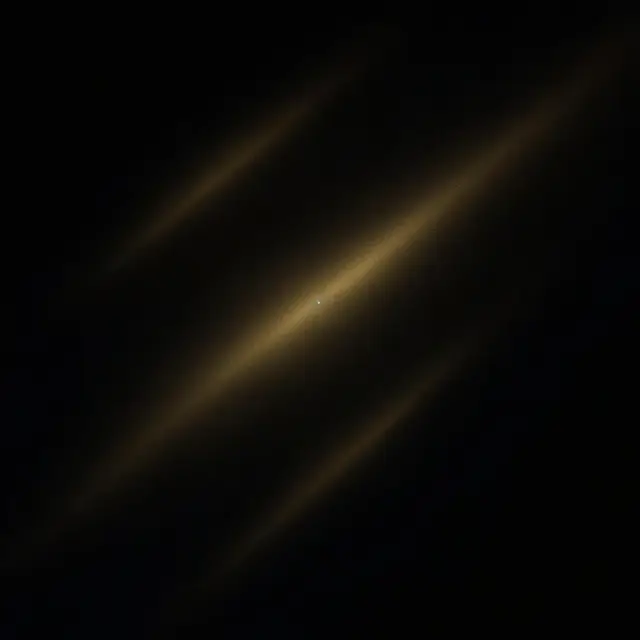
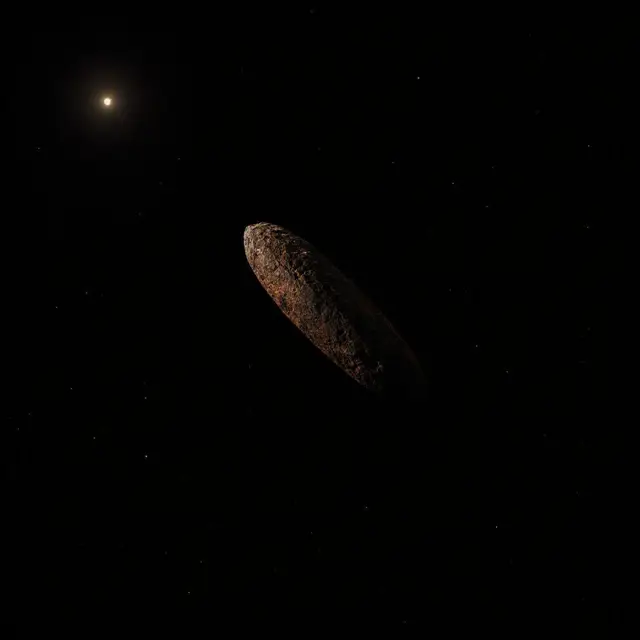
ʻOumuamua never appeared as more than a point of light even in the most powerful telescopes, so everything we know comes from its brightness rising and falling as it rotated — its light curve. And that light curve was bizarre: the object's brightness swung so wildly that it must be extremely elongated, perhaps 100 to 1,000 meters long but strikingly thin, with some estimates suggesting proportions like 115 by 111 by 19 meters.
Either a cosmic cigar or a great flat pancake — astronomers still cannot say which. Its surface is reddish, like bodies from the outer Solar System, and instead of spinning cleanly it tumbles, turning chaotically end over end roughly every 7 to 8 hours, likely the scar of some ancient violent event.
The Push Nobody Could Explain
Comets accelerate as they leave the Sun: their ices boil off into a glowing coma and tail, and the escaping gas pushes them like a weak rocket. In June 2018, astronomers confirmed ʻOumuamua was also accelerating beyond what gravity allows — but it had no coma, no tail, no visible outgassing at all. That contradiction became one of the strangest puzzles in modern astronomy.
Explanations multiplied. Perhaps it was made of frozen hydrogen, whose escaping gas is nearly invisible — though later work showed hydrogen icebergs shouldn't survive long interstellar journeys. A 2021 proposal imagined a shard of frozen nitrogen from a Pluto-like exoplanet that lost 92% of its mass passing our Sun. In 2023, scientists offered a quieter answer: ordinary water ice, bombarded by cosmic rays during its long journey, had built up trapped hydrogen that gently vented when warmed — no visible tail required.
Rock, Shard — or Something Built?
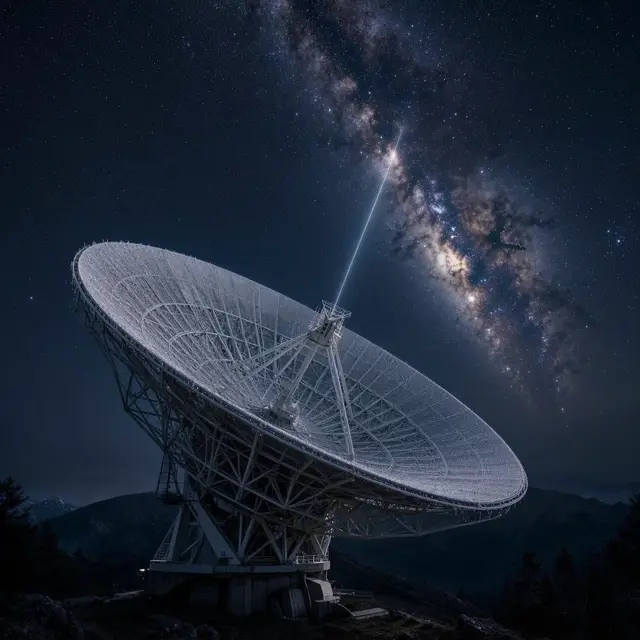
The strange shape and the unexplained push led Harvard astronomer Avi Loeb to a headline-grabbing suggestion: the possibility of an artificial origin deserved investigation. In December 2017, the Green Bank Telescope listened to ʻOumuamua for six hours across radio frequencies.
It heard nothing. No signals were detected, and by July 2019 most astronomers had concluded the visitor was a natural object — likely a comet-like planetesimal relic, broadly similar to our own, shaped and scarred by its journey. The debate over its precise nature remains open simply because the observation window was so short. ʻOumuamua entered from the direction of the star Vega, swept past the Sun, and is now leaving toward the constellation Pegasus at about 26 kilometers per second. It crossed Neptune's orbit outbound in 2022. It is never coming back.