Something Invisible Is Tugging Our Galaxy Off Course
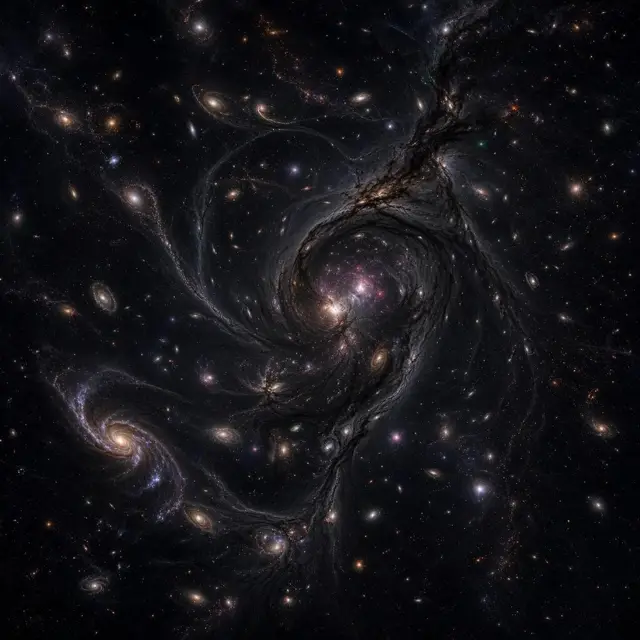
Our Milky Way galaxy is moving through space at incredible speed, and not just because of the universe's ongoing expansion. Something massive and unseen is pulling it, along with thousands of other galaxies, toward one patch of sky. Astronomers call this pull the Great Attractor.
The Great Attractor isn't one giant object like a black hole. It's a region where mass has piled up so densely that its gravity yanks galaxies off their expected paths. Scientists measure this pull by tracking each galaxy's peculiar motion, the leftover speed after subtracting the universe's steady expansion. Near the Great Attractor, galaxies race along at up to 700 kilometers per second faster or slower than expected.
A Wall of Stars Hides the Culprit
For decades, astronomers couldn't get a clear look at the Great Attractor. It sits behind our own galaxy's crowded core, in a region called the Zone of Avoidance. Stars, gas, and thick dust in the Milky Way block visible light, hiding whatever lies beyond.
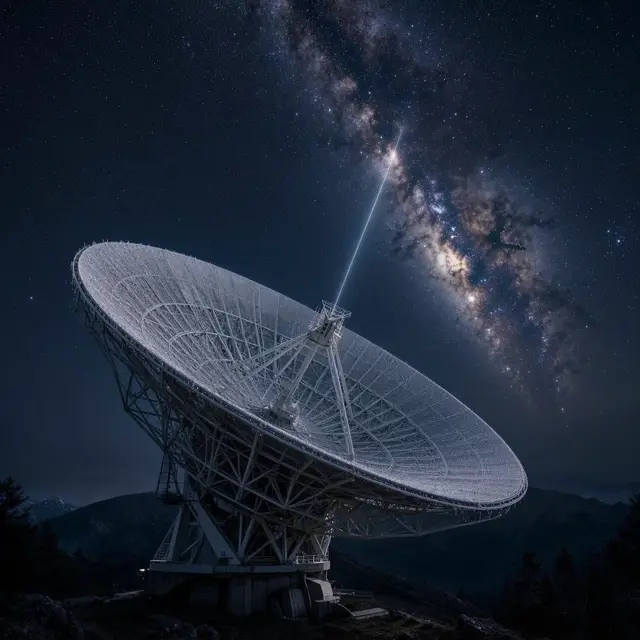
To see through this cosmic fog, researchers turned to different kinds of light. X-ray, radio, infrared, and neutral-hydrogen observations can pass through dust that blocks ordinary visible light. Using these tools, astronomers slowly mapped out galaxy clusters hidden directly behind the Milky Way's disk, revealing pieces of the puzzle one wavelength at a time. Even today, this blind spot makes the region one of the hardest parts of the sky to study.
Seven Scientists Named an Invisible Giant
The Great Attractor was identified in the 1980s by a team of seven astronomers, informally nicknamed the "Seven Samurai": David Burstein, Roger Davies, Alan Dressler, Sandra Faber, Donald Lynden-Bell, Roberto Terlevich, and Gary Wegner. It was Alan Dressler who coined the name.
Their work followed earlier hints, dating back to the 1970s, that galaxies weren't spreading apart from the Big Bang at a perfectly uniform rate. Something was disturbing the pattern. By carefully studying galaxy motions across a wide patch of sky, the team traced the disturbance to a single direction, toward the constellations Norma and Triangulum Australe.
How Heavy Is This Mystery Force?
Early estimates gave the Great Attractor a staggering mass, roughly ten thousand trillion times the mass of our Sun. Scientists reached that number by measuring how strongly nearby galaxies were being pulled off their expected courses. That's not the weight of one object, but the combined pull of an entire region crowded with galaxies and galaxy clusters.
Later research suggested this early figure was likely an overestimate. Still, at the heart of the Great Attractor's territory sits the enormous Norma Cluster, about 220 million light-years away, considered the main concentration of mass in the region. It anchors an even larger structure called the Norma Wall, a filament stringing together multiple galaxy clusters.
Just One Neighborhood in a Much Bigger Structure
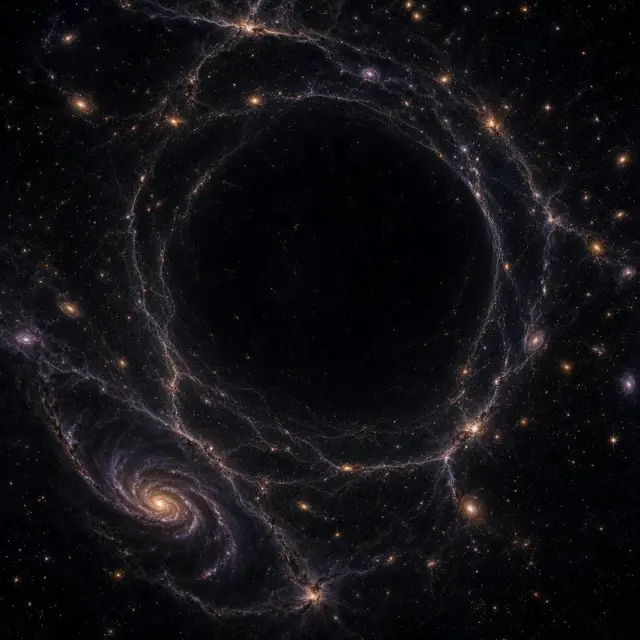
For years, the Great Attractor looked like the final answer to why our galaxy moves the way it does. Then, in 2014, astronomers redrew the map. They defined a colossal structure called the Laniakea Supercluster, stretching about 500 million light-years across and containing roughly 100,000 galaxies. The Great Attractor turned out to be sitting near Laniakea's gravitational center, not its outer edge.
Even Laniakea isn't the end of the story. The Great Attractor itself appears to be drifting toward a still more distant structure called the Shapley Supercluster. In 2024, researchers proposed that Laniakea might actually be a smaller piece of an even bigger basin of attraction centered on Shapley, meaning our galactic address keeps getting rewritten as bigger maps come into focus.