A Birthday Pinned Down to Two Decimals
The universe has a measured age: 13.787 billion years, give or take 0.02 billion. That precision comes from detailed measurements of how fast the universe is expanding, wound backwards.
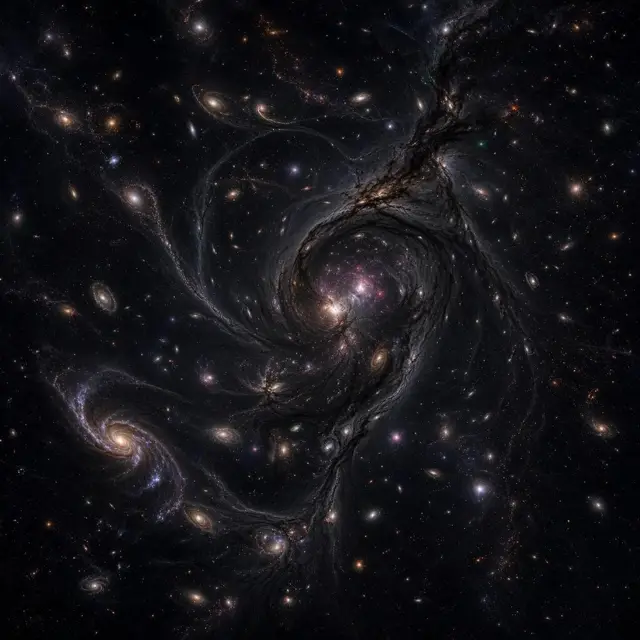
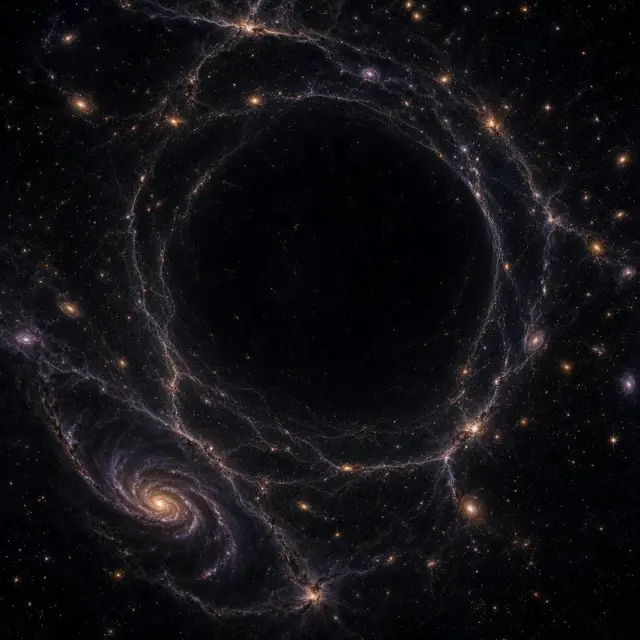
The Big Bang is a physical theory describing how the universe expanded out of an early state of enormous density and temperature. It is not one idea but a family of cosmological models, and they explain a wide spread of observations: the abundance of light elements, the cosmic microwave background, the redshift of galaxies, and the large-scale structure of everything.
One awkward detail needed fixing. The universe looks strangely uniform in every direction, which creates the horizon and flatness problems. The answer is cosmic inflation, a burst of accelerated expansion in the very earliest moments that smoothed everything out.
The Accident That Ended the Argument
For decades the Big Bang had a serious rival. The steady-state model held that the universe had no beginning and simply persisted. Choosing between them needed evidence nobody had.
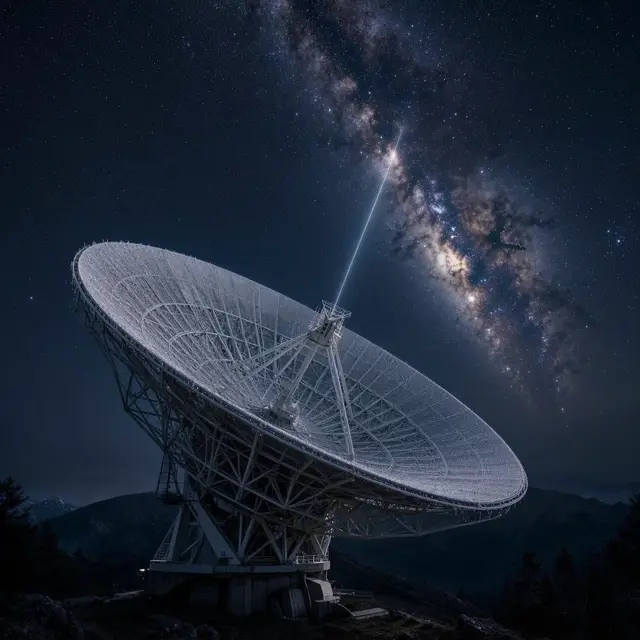
In 1964 the cosmic microwave background was discovered by accident. Follow-up measurements over the next few years showed this faint radiation to be uniform across every direction of the sky, and showed that its energy-versus-intensity curve matched exactly what you would expect from a universe that had once been searingly hot and dense.
That was decisive. By the late 1960s most cosmologists accepted that the steady-state picture was wrong. A stray hiss in a radio receiver had settled the origin of the universe.
Three People Who Saw It Coming
The theory was assembled by people working largely in isolation from one another. In 1922 the physicist Alexander Friedmann introduced the concept of an expanding universe by deriving the Friedmann equations mathematically, purely from theory.
In 1929 Edwin Hubble published the observational side, now known as Hubble's law: galaxies are moving away from Earth at a rate that rises in proportion to their distance. Working independently of both Friedmann's maths and Hubble's telescope, in 1931 Georges Lemaitre proposed that the universe emerged from what he called a "primeval atom".
That proposal is the modern notion of the Big Bang. Three separate routes, one conclusion, and none of them could see the full picture alone.
Almost Nothing Is the Stuff You Can See
Cosmologists have worked out what the universe is made of by combining astronomical observation with thermodynamics and particle physics. The answer is humbling.
Luminous matter, meaning every star, planet, moon and cloud of glowing gas, makes up less than 5% of the density of the current universe. Dark matter accounts for 27%. Dark energy, the thing driving the expansion to accelerate, makes up the remaining 68%.
The sequence that built that visible 5% went like this. After inflation ended, a reheating event converted the energy that drove it into a hot, dense plasma, starting the hot Big Bang. Expansion cooled things enough for subatomic particles to form, then atoms. Those primordial elements, mostly hydrogen with some helium and lithium, clumped under gravity with dark matter's help into the first stars and galaxies.
The Parts Still Unexplained
A wide range of evidence strongly favours the Big Bang and it is now widely accepted, but calling it finished would be a mistake. Several features of the observed universe are not yet adequately explained by the models.
One is baryon asymmetry: the universe contains far more matter than antimatter, and nobody has fully accounted for the imbalance. Another is the detailed nature of the dark matter that surrounds galaxies. A third is the origin of dark energy itself.
There has also been a shift in the picture over time. The original model extrapolated all the way back to a singularity, a point of infinite density. The modern view replaces that with inflation, describing a universe that emerged from a supercooled state instead. The theory keeps being rebuilt from the inside.