The Boundary With No Sign On It
A black hole is an astronomical body so compact that its gravity prevents anything — including light — from escaping. Albert Einstein's theory of general relativity, which describes gravitation as the curvature of spacetime, predicts that any sufficiently compact mass will form one.
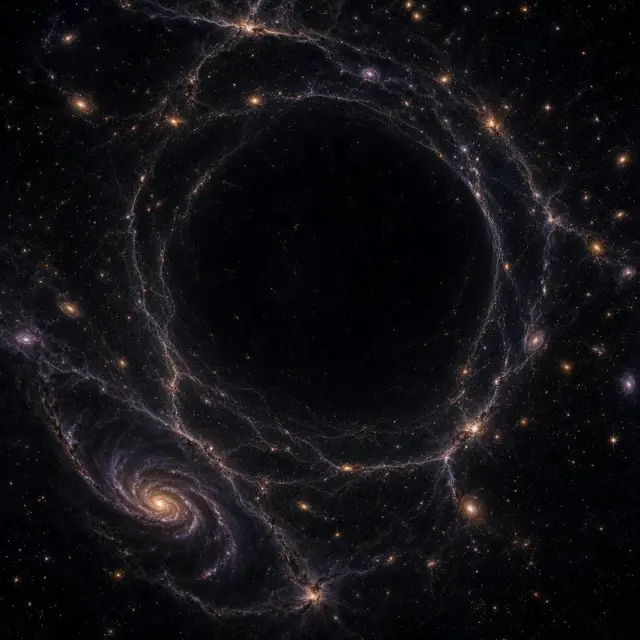
The boundary of no escape is called the event horizon, and general relativity says something genuinely unsettling about it: crossing it traps an object inside, but produces no locally detectable change. There is no wall, no flash, no alarm. You would not be able to tell from inside your own ship that the most irreversible event in physics had just happened.
The theory also predicts that every black hole has a central singularity, a point where the curvature of spacetime becomes infinite. Infinity in a physical theory usually means the theory has run out of road — which is exactly why black holes remain so interesting.
Forty Years as a Curiosity
Objects whose gravity was too strong for light to escape were first considered in the 18th century. The first solution of general relativity that would characterise a black hole was found in 1916.
And then, essentially, nothing. It was not until the late 1950s that this solution began to be interpreted physically, as a region of space from which nothing can escape. Black holes were long treated as a mathematical curiosity — a quirk of the equations rather than a description of anything real.
Only in the 1960s did theoretical work show they were a generic prediction of general relativity, not an exotic special case. The first widely accepted black hole was Cygnus X-1, an X-ray source proposed as a black hole binary through several studies between 1971 and 1974. From equation to accepted object took roughly sixty years.
How to See Something Invisible
A black hole emits nothing. Everything we know about them comes from watching what happens around them.
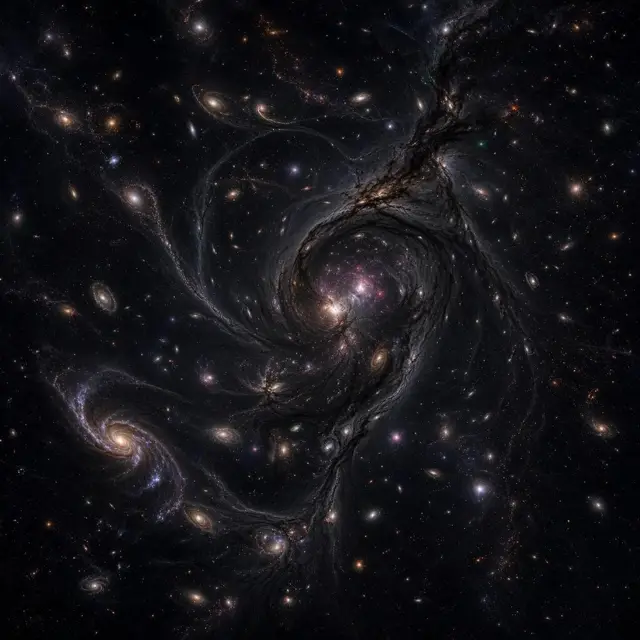
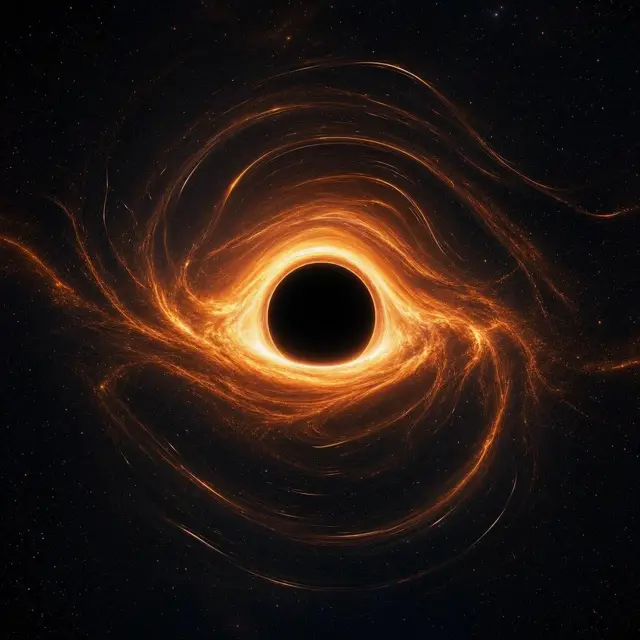
Matter falling toward one can form an accretion disk of infalling plasma, heated by friction until it emits light. In extreme cases this produces a quasar — among the brightest objects in the universe, powered by material in the act of falling into darkness.
There are other routes. Merging black holes can be detected by the gravitational waves they emit. And if stars orbit one, their motions reveal its mass and location. That method delivered the headline result: astronomers established that Sagittarius A*, the radio source at the core of the Milky Way, contains a supermassive black hole of about 4.3 million solar masses. There is consensus that supermassive black holes sit at the centres of most galaxies.
They Evaporate, Very Slowly
Black holes typically form as part of a supernova, when massive stars collapse at the end of their lives. Once formed, they grow by absorbing surrounding mass. Supermassive ones, of millions of solar masses, may build up by swallowing stars, merging with other black holes, or through the direct collapse of gas clouds.
But they are not permanent. Quantum field theory in curved spacetime predicts that event horizons emit Hawking radiation, at a rate inversely proportional to mass — smaller black holes radiate faster. This causes a black hole to lose mass very slowly, provided it is not accreting anything.
That proviso does a lot of work. Even the smallest observed class, stellar black holes, are currently gaining mass from the cosmic microwave background faster than they lose it to Hawking radiation. The universe is still feeding them faster than they can starve — for now.