One particle with the punch of a baseball
Cosmic rays are tiny particles, mostly protons and atomic nuclei, that race through space at nearly the speed of light. They come from the Sun, from across the Milky Way, and from distant galaxies.
Most carry modest energy, peaking at around 300 million electronvolts. But a rare few are monsters. The most powerful ones, such as one recorded in 1991, carry about 50 joules. That is roughly the energy of a baseball flying at 90 km/h, packed into one particle. It is more than 10 million times the energy the Large Hadron Collider was designed to give its particles.
Where do such giants come from? In 2013, data from the Fermi Space Telescope showed that supernovae, the huge explosions of stars, are one source. In 2018, observations suggested that the bright, active centers of some galaxies make them too. Scientists are still working out the rest.
A balloon ride that found them
In the early 1900s, scientists noticed that the air carried a small electric charge, and they wanted to know why. In 1909, Theodor Wulf took his electrometer up the Eiffel Tower and found more radiation at the top than at the base. His paper was not widely accepted. In 1911, Domenico Pacini measured less radiation 3 meters underwater, hinting at a source other than the Earth itself.
Then, in 1912, Victor Hess carried three improved electrometers up to 5,300 meters in a free balloon. The radiation rate doubled compared to the ground. He even made a flight during a near-total eclipse. With the Moon blocking much of the Sun, the radiation still rose with height, so the Sun could not be the source.
Hess concluded that powerful radiation was entering our atmosphere from above. That discovery earned him the Nobel Prize in Physics in 1936.
Not really rays at all
The name is a leftover from a wrong guess. In the 1920s, Robert Millikan coined the term 'cosmic ray' and believed they were gamma rays, which are energetic particles of light. In 1927, while sailing from Java to the Netherlands, Jacob Clay found that the intensity grew from the tropics to the middle latitudes. That meant Earth's magnetic field was bending them, so they had to be charged particles, not light.
We now know what they are made of. About 99 percent of primary cosmic rays are bare atomic nuclei, stripped of their electrons. The other 1 percent are lone electrons. Of the nuclei, about 90 percent are protons, 9 percent are helium nuclei, and 1 percent are heavier elements. A tiny fraction is even antimatter.
In 1930, Bruno Rossi predicted that more cosmic rays would arrive from one direction than the other. Experiments found more coming from the west, proving most are positively charged.
A particle shower falling through you
When a cosmic ray hits the upper atmosphere, it crashes into oxygen and nitrogen atoms. The result is an air shower, a cascade of lighter particles raining down. In 1937, Pierre Auger studied these showers and showed how one particle high up sets off a spray that reaches the ground.
Some of that spray is made of muons. They barely interact with matter, so they shoot through the air and even underground, into shallow mines. About one muon per second passes through a space the size of a person's head. Most of the neutrinos made in these showers travel right through the whole Earth.
At 12 km, airline passengers and crews get at least 10 times the cosmic ray dose of people at sea level. Cosmic rays also keep making carbon-14 in the air. They held its level steady at about 70 tons for at least 100,000 years before the 1950s, a fact used in radiocarbon dating.
Flipped bits, a confused probe and lightning
Cosmic rays can mess with computers. A hit can change the state of a tiny circuit and corrupt data, causing what engineers call soft errors. Studies by IBM in the 1990s suggested a typical computer saw about one such error per 256 megabytes of memory each month. Shrinking transistors make this a growing worry on the ground too.
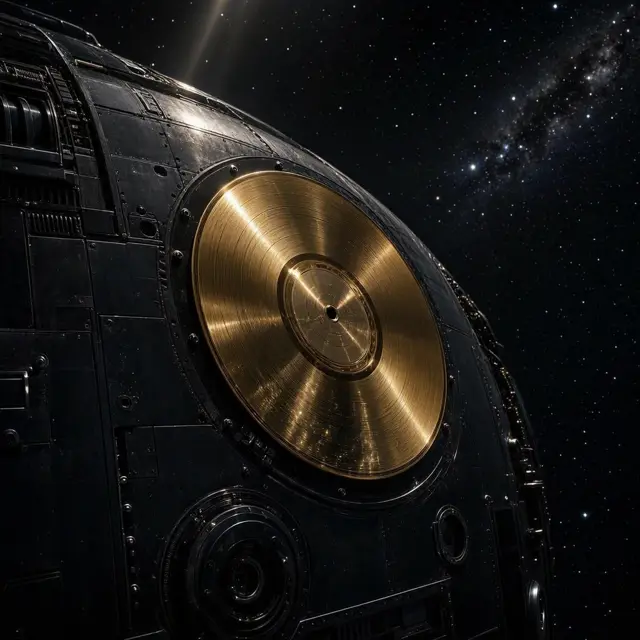
Space is worse. In 2010, a malfunction aboard the Voyager 2 probe was traced to a single flipped bit, probably caused by a cosmic ray. These particles are also one of the biggest barriers to sending crews to other planets.
They may even start lightning. One idea holds that almost all lightning is triggered by particles from cosmic ray showers. You can even hunt them yourself. Smartphone camera chips can pick up air showers, and in 2017 the CREDO project released an open source app for Android phones. A simple cloud chamber built in a high-school lab shows them too.