Kelvin's Dark Bodies and Zwicky's Hidden Mass
The idea is older than you might think. In lectures given in 1884, Lord Kelvin looked at how fast stars near the Sun were moving and tried to work out how many there were. He concluded that many of them, perhaps most, might be "dark bodies". In 1906, Henri Poincaré used the French term for "dark matter" while discussing Kelvin's work.
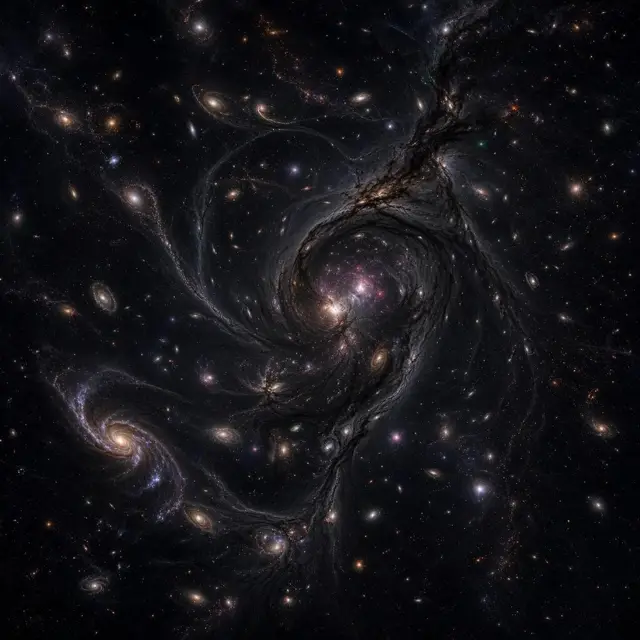
The big leap came in 1933. Swiss astrophysicist Fritz Zwicky studied the Coma Cluster, a huge galaxy cluster. Galaxies near its edge were moving far too fast. The gravity of the visible galaxies was much too weak to hold them, so some unseen mass had to be there. He called it dunkle Materie, German for dark matter.
Zwicky guessed the cluster had about 400 times more mass than could be seen. That was off by more than ten times, mainly because he used an outdated value of the Hubble constant. Still, his main point was right: most of the mass was dark.
Galaxies That Spin Too Fast
Think of the Solar System. Planets far from the Sun move more slowly than close ones, because most of the mass sits in the middle. Spiral galaxies also have most of their visible stars packed toward the center. So their outer stars and gas should move slowly, too.
They don't. A galaxy's rotation curve stays flat or even rises toward the edge. In the 1970s, Vera Rubin and Kent Ford measured this with a new, more accurate spectrograph. At the same time, radio astronomers traced hydrogen gas far beyond the visible stars in galaxies like Andromeda. The outer parts kept spinning fast.
The simplest explanation is a lot of unseen matter in the outskirts. In 1974, two independent teams, one in Princeton and one in Tartu, Estonia, argued that galaxies are surrounded by huge halos of it. By the late 1970s, these halos were widely accepted as real, and dark matter had become a major unsolved problem in astronomy.
Weighing the Invisible With Bent Light
Gravity bends light. A massive object sitting between us and a faraway galaxy acts like a lens, an effect called gravitational lensing. The more mass, the more bending. Around some clusters, background galaxies get stretched into arcs, and measuring those shapes reveals how much mass is in the way, whether it shines or not.
A galaxy cluster can be weighed in three separate ways: from how fast its galaxies move, from the X-rays given off by its hot gas, and from lensing. All three roughly agree that dark matter outweighs visible matter by about 5 to 1.
The star witness is the Bullet Cluster, the result of two galaxy clusters colliding. The hot, visible gas in each cluster was slowed down in the crash. The dark matter was not, so the two separated. Lensing shows the center of mass sitting in a different place from the visible gas, which is hard to explain with modified gravity alone.
The Universe's Strange Recipe
According to the standard model of cosmology, only 5% of the universe is ordinary matter, the stuff of stars and planets. Dark matter makes up 26.8%, and the remaining 68.2% is dark energy. That means dark matter is about 85% of all the mass out there.
Could it just be dim ordinary stuff? Mostly not. The amounts of helium and lithium made in the Big Bang only fit if ordinary matter is 4 to 5% of a key cosmic density, while other measurements put all matter at about 30%. Tiny temperature ripples in the cosmic microwave background also show that about five-sixths of all matter is a different kind.
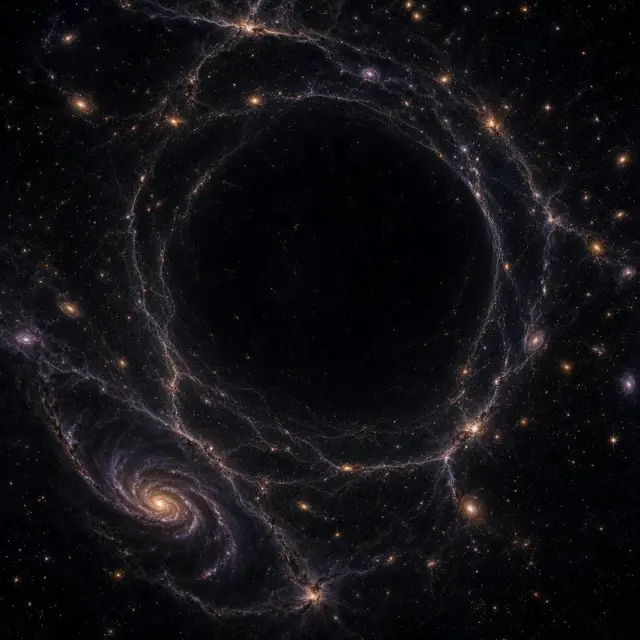
Strangely, there is not much of it near us. All the dark matter out to the orbit of Neptune would add up to about the mass of one large asteroid. Out in space, though, it acts as hidden scaffolding for a vast cosmic web of galaxies.
Hunting a Particle No One Has Caught
Most scientists think dark matter is a particle no one has found yet. The long-time favorite is WIMPs. To catch one, experiments fill detectors with liquid xenon or argon deep underground, away from cosmic rays, and watch for a faint flash of light when a particle bumps into an atom. As of late 2025, there was still no confirmed detection. The LZ detector has even started picking up a "neutrino fog" from the Sun that mimics the signal.
That shifted attention to axions, extremely light particles first proposed in 1978. Another idea is primordial black holes. Interest grew after LIGO first detected gravitational waves in 2015, and after the James Webb Space Telescope spotted surprisingly huge black holes less than 500 million years after the Big Bang.
A minority of scientists think gravity itself needs fixing instead. But so far, no modified gravity theory can explain every piece of evidence at the same time.