The Only Place Known to Hold Life
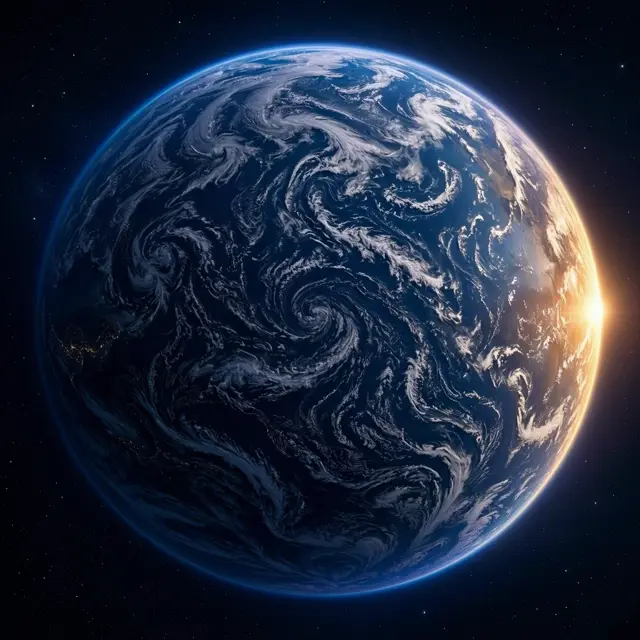
Of every object astronomers have ever studied, exactly one is known to harbour life. Earth, the third planet from the Sun, owes that to water. It is an ocean world, the only one in the Solar System with liquid water on its surface.
Almost all of that water sits in the ocean, which covers 70.8% of Earth's crust. The other 29.2% is land, mostly gathered in one hemisphere as continental landmasses, much of it humid and covered with vegetation.
Here is a detail that surprises most people: the great ice sheets of Earth's polar deserts hold more water than all of the planet's groundwater, lakes, rivers and atmospheric water combined. Much of the fresh water on the planet is locked away as ice.
A Blanket Above and a Shield Below
Earth's atmosphere is made mostly of nitrogen and oxygen. It shields the surface from most meteoroids and from much of the Sun's ultraviolet light. Water vapour forms clouds that cover most of the planet.
Water vapour also acts as a greenhouse gas. Together with others, particularly carbon dioxide, it traps energy from sunlight and keeps the average surface temperature at 14.76 degrees Celsius, where water stays liquid. Because the equator gets more sunlight than the poles, that trapped energy drives air and ocean currents, creating the global climate system and its weather.
The protection goes deeper. Earth has a liquid outer core that generates a magnetosphere, a magnetic shield that deflects most of the damaging solar wind and cosmic radiation. Meanwhile the crust is split into slowly moving tectonic plates, which push up mountain ranges and cause volcanoes and earthquakes.
The Numbers That Define Home
Earth is not a perfect sphere. It is rounded into an ellipsoid with a circumference of about 40,000 kilometres (24,900 miles). It is the densest planet in the Solar System and the largest and most massive of the four rocky planets. Counting everything, it is the sixth largest object in the Solar System, after the Sun and the outer planets.
Sunlight takes about eight minutes to reach us. Earth takes about 365.25 days to orbit the Sun once, and it spins on its own axis in slightly less than a day: about 23 hours and 56 minutes.
That axis is tilted relative to the plane of Earth's orbit, and the tilt is what gives us seasons. As the planet travels around the Sun, each hemisphere takes its turn leaning toward the light and then away from it.
The Moon's Quiet Job
Earth has one permanent natural satellite, the Moon. It orbits at 384,400 kilometres (238,855 miles), about 1.28 light seconds away, and it is roughly a quarter as wide as Earth.
The Moon does more than light up the night. Its gravity helps stabilise the tilt of Earth's axis, which keeps our seasons steady over time. It causes the tides. And it is gradually slowing Earth's rotation, lengthening our days by a tiny amount over enormous spans of time.
The pull runs both ways. Earth's gravity has already made the Moon tidally locked, so the Moon always keeps the same side facing us. Every human who has ever looked up has seen the same face of the Moon, while its far side stays hidden from the ground.
4.5 Billion Years in Brief
Earth formed about 4.5 billion years ago from gas and dust in the early Solar System, like most of its neighbours. Within its first billion years, the ocean had formed and life had begun.
Life did not just live on Earth. It changed it. As living things spread across the globe, they altered the atmosphere and the surface, leading to the Great Oxidation Event about two billion years ago, when oxygen built up in the air.
Humans are late arrivals. Our species emerged about 300,000 years ago in Africa and has since spread to every continent. We depend on Earth's biosphere and natural resources to survive, yet we have increasingly reshaped the planet's environment. Humanity's current impact on Earth's climate and biosphere is described as unsustainable, threatening the livelihood of humans and many other forms of life.