The Brightest Little World in the Solar System
William Herschel discovered Enceladus on August 28, 1789, with his giant 40-foot telescope — and for nearly two centuries, that was almost all we knew. The moon is tiny, about 500 kilometers across, a tenth the size of Saturn's giant moon Titan, and it hides beside Saturn's dazzling rings.
What eventually made it famous is its shine. Enceladus is the most reflective body in the Solar System, blanketed in clean, freshly fallen snow hundreds of meters thick — up to 700 meters in places. All that mirror-bright ice bounces sunlight away, chilling the noon surface to −198°C. When the Voyager probes flew past in the early 1980s, they saw something odd for a small frozen moon: vast smooth regions with few craters. Something had recently repaved the surface.
Geysers at the South Pole
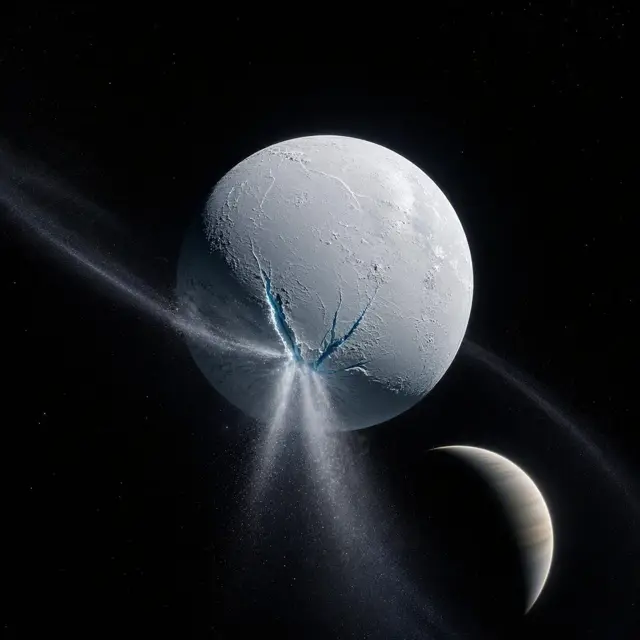
The answer came in 2005, when the Cassini spacecraft began close flybys and caught Enceladus in the act: geyser-like jets of ice erupting from the south pole. More than 100 geysers blast roughly 200 kilograms of material into space every second, with particles racing up to 2,189 kilometers per hour.
The jets pour from four great fractures nicknamed the tiger stripes — among the youngest features on the moon, likely under 1,000 years old. Some of the spray falls back as fresh snow; the rest escapes and feeds Saturn's E ring, meaning one of Saturn's rings is literally made of Enceladus. The plumes are mostly water vapor laced with carbon dioxide, methane, ammonia, and organic compounds — and they grow about four times brighter when the moon is farthest from Saturn, as tidal forces pull the cracks open.
The Ocean Under the Ice
Where does all that water come from? Cassini's measurements delivered the answer in stages. Gravity data from 2010 hinted at a sea beneath the south pole. Then scientists measured the moon's libration — a subtle wobble of 0.120 degrees as it orbits. The ice shell wobbles too much to be frozen onto the rock below. The entire crust is floating.
Enceladus has a global ocean of liquid water beneath 30 to 40 kilometers of ice, thinning to about 10 kilometers at the south pole. The ocean itself is estimated at 26 to 31 kilometers deep — seven to eight times the average depth of Earth's oceans, wrapped around a moon smaller than many countries. It is salty, alkaline, and in direct contact with a warm rocky core.
Nearly Every Ingredient for Life
In 2015, Cassini dove within 48.3 kilometers of the south pole and flew straight through the plume, tasting the ocean directly. It found molecular hydrogen — the chemical signature of hydrothermal vents, where hot water reacts with rock on the ocean floor. On Earth, such vents host thriving ecosystems that never see sunlight; the hydrogen itself is food for microbes that combine it with carbon dioxide to make methane.
The inventory has kept growing: complex organic molecules with at least 15 carbon atoms, then phosphates in June 2023 — completing the basic chemical ingredient set for life — and hydrogen cyanide, a building block for life's molecules, that December. The moon even radiates far more heat than simple models predicted: 4.7 gigawatts from the south polar region. No one claims life exists there. But proposed missions with names like Enceladus Life Finder exist for one reason: it is currently one of the best places in the Solar System to look.