A Clue That Waited a Century
In 1917, the astronomer Walter Sydney Adams took a reading of the light from a star called Van Maanen 2. He took it to be an ordinary kind of star. Nearly a century later, in 2016, researchers looked at that old reading again and saw something new.
The odd pattern in the light could be dust from a nearby planet that the star's gravity had ripped apart. That dust was falling onto the star. So the first evidence of a planet beyond our Solar System sat unnoticed for almost 100 years.
Today such worlds are called exoplanets, meaning planets outside the Solar System. As of 1 October 2026, there were 6,375 confirmed exoplanets in 4,772 planetary systems. More than a thousand of those systems have more than one planet.
The First Finds Were the Weirdest
The first definite discovery came in 1992, and it was not where anyone expected. Aleksander Wolszczan and Dale Frail found two planets circling a pulsar, the tiny, dense leftover of an exploded star. Pulsars are so harsh that planets there were thought unlikely.
In 1995, Michel Mayor and Didier Queloz found a giant planet circling an ordinary, Sun-like star called 51 Pegasi, on a four-day orbit. The find started the modern era of planet hunting and earned a share of the 2019 Nobel Prize in Physics.
Those early planets shocked astronomers. Many were huge planets hugging their stars, now called hot Jupiters. Theory said giant planets should only form far out. Yet back in 1952, Otto Struve had already suggested that big planets in tight orbits could exist and could be found.
Spotting Shadows and Wobbles
Finding an exoplanet is hard because stars are blinding. A Sun-like star is about a billion times brighter than the light reflected by any planet around it. So almost all exoplanets are found indirectly.
The transit method watches for a tiny dip in a star's brightness when a planet passes in front of it. The Kepler space telescope used this, and in 2014 NASA announced 715 newly verified planets at once. The other big method tracks the star's wobble. A planet tugs its star in a small circle, and the star's radial velocity, its speed toward or away from us, can be measured to about 1 meter per second.
There are clever extras too. When a star's gravity acts like a lens on light from a star far behind it, a planet can add a tiny blip. This is called gravitational microlensing.
Blue, Magenta and Darker Than Coal
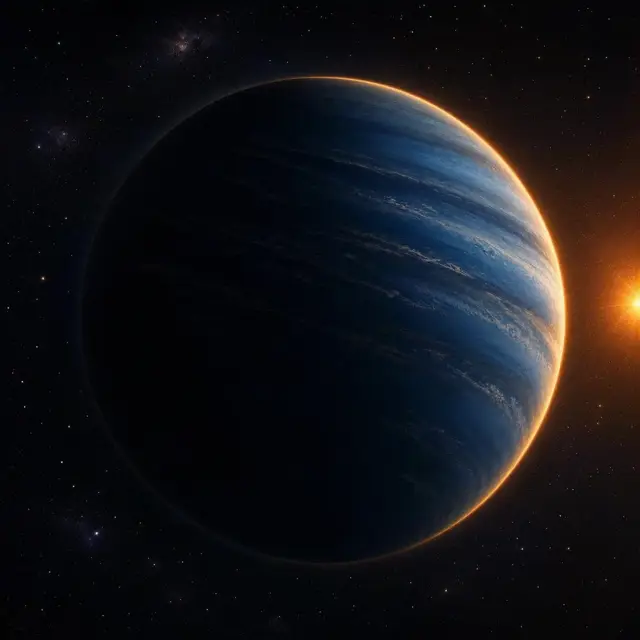
In 2013, astronomers worked out the color of an exoplanet for the first time. HD 189733b appears deep dark blue. Later that year they found GJ 504 b, which looks magenta.
Then there is TrES-2b, the darkest known planet. Its albedo, how much light it reflects, is less than 1 percent. That makes it darker than coal or black acrylic paint, and nobody knows exactly why.
Some planets are falling apart. Kepler-1520b is a small rocky world so close to its star that it is evaporating, trailing a tail of dust like a comet. GJ 436 b has a tail of gas 14 million kilometers long. Planets that always face their star with one side could look like an eyeball, with a scorching hot spot as the pupil. Some planets race around their stars in less than an hour, while others take thousands of years.
Is Anybody Out There?
The big question is life. Scientists focus on the habitable zone, sometimes called the goldilocks zone, where it is neither too hot nor too cold for liquid water on the surface.
The numbers are huge. About 1 in 5 Sun-like stars may have an Earth-sized planet in that zone. With 200 billion stars in the Milky Way, that could mean 11 billion potentially habitable Earth-sized planets, or 40 billion if we count small red dwarf stars.
The nearest exoplanets are just 4.2 light-years away, around Proxima Centauri, the closest star to the Sun. One of them, Proxima Centauri b, sits in its star's habitable zone. There are also rogue planets drifting alone with no star at all, possibly billions of them in our galaxy. Exomoons may exist too, but none has been confirmed so far.