A Storm Three Earths Wide
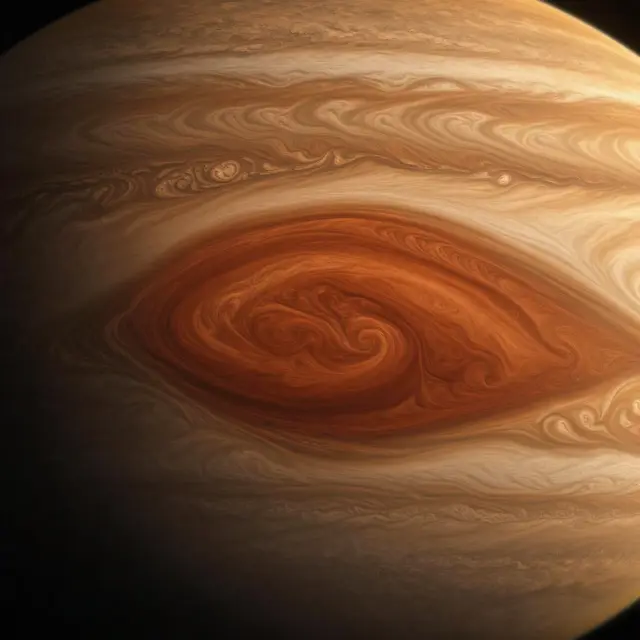
Picture a storm that, more than a century ago, measured about 40,000 km across. That is roughly three times the width of Earth. Meet the Great Red Spot, a giant storm on Jupiter and the largest anticyclone in the Solar System.
It sits 22 degrees south of Jupiter's equator, with winds of up to 496 km/h (308 mph). Its cloud tops rise about 8 km above the clouds around it. It spins counterclockwise, making one full turn in about 4.5 Earth days.
Why has it lasted so long? Jupiter has no solid surface to slow the storm down through friction, only a deep layer of hydrogen. With nothing to oppose its spin, the storm has kept turning for centuries. Its spin has slowed over time, though, perhaps because the storm keeps getting smaller.
Who Really Saw It First?
Robert Hooke is often credited with spotting it first, in May 1664. But his spot was probably in a different cloud belt, and may have been the shadow of a passing moon, most likely Callisto. A year later, Giovanni Cassini described a "permanent" spot that kept returning to the same place with the same size and shape.
Cassini's spot was seen on and off from 1665 to 1713. Then the records go quiet for more than a century. The modern spot has been watched since 5 September 1831, and nonstop since the late 1870s. A 2024 study suggests Cassini's spot disappeared and a new one formed later: the storm we see today.
There is a small art mystery too. A 1711 painting by Donato Creti shows a large spot on Jupiter in red. It is the first known picture of such a spot as red, even though nobody described anything on Jupiter as red in writing until the late 19th century. The painter even placed it in the wrong half of the planet, because telescopes of that era flipped the image.
The Incredible Shrinking Storm
The Great Red Spot is getting smaller. By 2004, it was about half as long as it had been a century earlier. In April 2017, it measured 16,350 km wide. If it keeps shrinking at the present rate, it will become a circle by 2040.
In 2019, things got stranger. The spot began "flaking" at its edges, as pieces of the storm spun off and faded away. Some astronomers took this as a sign that the spot could vanish within decades.
Others are not so worried. They think the visible size only shows the cloud cover, not the true size of the spinning vortex below. They also say the flaking can be explained by run-ins with other storms, including small ones the spot did not fully swallow. If they are right, the Great Red Spot may not be in danger of disappearing at all.
A Cold Storm Under a Red-Hot Sky
Infrared data shows that the storm's clouds are colder than most clouds on Jupiter, which means they sit higher up. Yet the air far above the storm is surprisingly hot, around 1,600 K (1,330 °C). That is several hundred degrees warmer than the rest of the planet at the same height.
One proposed explanation is sound. Scientists have suggested that acoustic waves rising from the stormy turbulence below travel up about 800 km, then break in the upper air and turn their energy into heat. The effect has been compared to ocean waves crashing on a beach.
In July 2017, NASA's Juno spacecraft flew about 8,000 km above the storm and scanned it with its microwave radiometer. The data suggests the storm reaches roughly 200 to 500 km below the clouds. So this giant is far wider than it is deep, more like a huge pancake of wind than a tall tower.
Brick Red, Salmon or White
Nobody knows for sure why the spot is red. Lab experiments suggest that ultraviolet light from the Sun blasts chemicals high in the storm, such as ammonium hydrosulfide and acetylene. That creates a reddish material, likely complex compounds called tholins. In other words, the storm has a sunburn.
The color changes a lot, too. The spot can look brick red, pale salmon or even white. Sometimes it almost vanishes, and only a gap in the clouds called the Red Spot Hollow shows where it sits. Oddly, when the South Equatorial Belt around it turns bright white, the spot usually looks dark, and the other way around.
It even has a little sibling. In March 2000, three white storms merged into one called Oval BA, which later turned reddish. Astronomers nicknamed it the Little Red Spot, or Red Jr. The two storms pass each other about every two years, and in July 2006 they slid past each other without merging.