A Telescope Above the Air
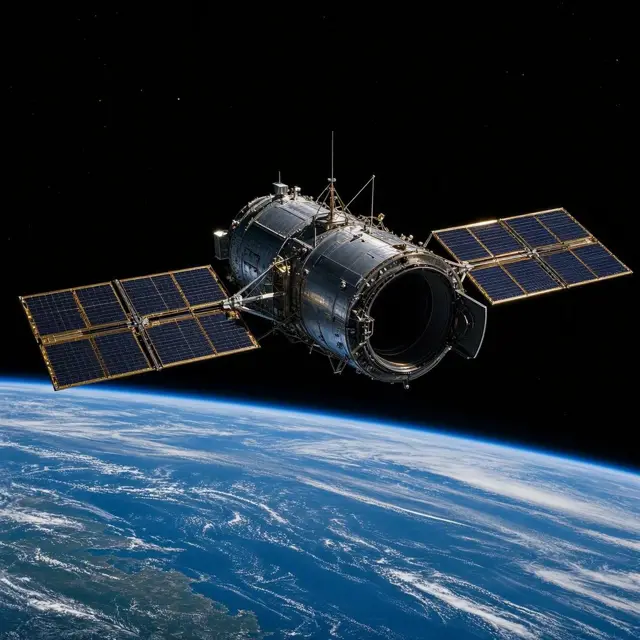
Hubble is a space telescope in low Earth orbit, launched in 1990 and still working. It carries a mirror 2.4 metres across and five main instruments that observe in ultraviolet, visible and near-infrared light.
The advantage is simply where it sits. Earth's atmosphere blurs starlight and adds background glow, and above it Hubble can produce extremely sharp images with a much darker sky behind them. That has produced results that ground telescopes could not, including a measurement of how fast the universe is expanding.
It was funded and built by NASA in the 1970s with help from the European Space Agency, and named after the astronomer Edwin Hubble. The launch was meant to happen in 1983, but technical delays, budget trouble and then the Challenger disaster in 1986 pushed it back for years.
Those years were expensive. The telescope waited in a clean room, powered up and purged with nitrogen, at a cost of about 6 million dollars a month. It finally launched aboard Discovery on 24 April 1990.
The Mirror Was Wrong
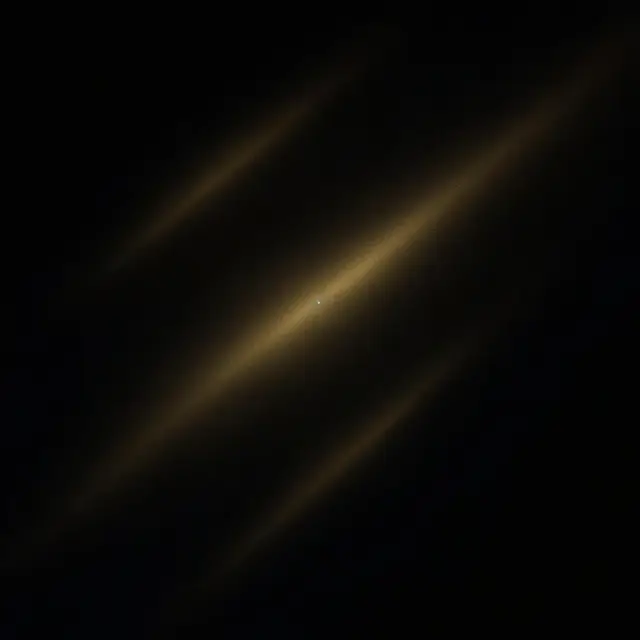
Within weeks of launch the images showed something was badly wrong. Points of light spread out over more than ten times the radius the design allowed.
Analysis found that the primary mirror had been polished to the wrong shape. It was one of the most precisely figured mirrors ever made, smooth to about 10 nanometres, but its outer edge was too flat by about 2,200 nanometres, roughly one four hundred and fiftieth of a millimetre. That tiny error produced severe spherical aberration, where light from the rim of the mirror focuses at a different point than light from the centre.
The damage was uneven. Bright objects could still be observed at high resolution, but faint ones were swamped by an out of focus halo, which made nearly all the cosmology programmes impossible. Politicians questioned NASA's competence and comedians had a field day. A 1991 film showed Hubble alongside the Titanic and the Hindenburg.
An inquiry found a testing device had been assembled with one lens 1.3 millimetres out of position. Other tests had correctly reported the flaw and been dismissed.
Spectacles for a Telescope
A spare mirror existed, but swapping it in orbit was impossible and bringing the telescope home was too slow and expensive. The solution came from the nature of the mistake: the mirror had been ground very precisely to the wrong shape, so new optics could be built with exactly the same error in reverse.
Astronomers first had to measure the flaw exactly, working backwards from images of single stars. Two different corrections were then needed. The replacement camera could have the inverse error built into its own relay mirrors. The other instruments had no such surface, so they got an external device called COSTAR, which had to be squeezed in by removing an instrument entirely.
Servicing Mission 1 flew aboard Endeavour in December 1993 and ran ten days. The crew trained with about a hundred specialised tools and ran seven full mission simulations, the most thorough preparation in shuttle history. During vacuum training, one astronaut discovered that spacesuit gloves did not protect adequately against the cold, since this repair had to happen out of sunlight, and NASA changed the equipment and the flight plan.
Kept Alive by Hand
On 13 January 1994 NASA declared the repair a complete success and released the first sharp images. It was among the most complex missions attempted to that point, with five long spacewalks, and it rescued both the telescope and the agency's reputation.
Hubble was designed from the start to be serviced, with each instrument and short-lived part built as an orbital replacement unit. Five servicing missions flew in total, the last in May 2009. Each began with the shuttle catching the telescope using its robotic arm, followed by four or five days of tethered spacewalks to repair, replace and upgrade, and usually a boost to a higher orbit to counter the drag that slowly pulls it down.
By 2002 every instrument that needed COSTAR had been replaced by one with its own built-in correction, so COSTAR itself became unnecessary. It was removed in 2009 and brought home, and now sits in a museum in Washington.