A House Moving at 27,600 km/h
Since 2 November 2000, there has always been someone living aboard the International Space Station. That is the longest stretch of continuous human presence in space, and by August 2025, 290 people from 26 countries had visited.
The station flies about 400 kilometres above Earth at 27,600 km/h, going all the way around the planet roughly every 93 minutes. That works out to 15.5 laps a day. Because it moves so fast, the crew sees 16 sunrises and sunsets every single day, so the windows are covered during sleep time to create a normal night.
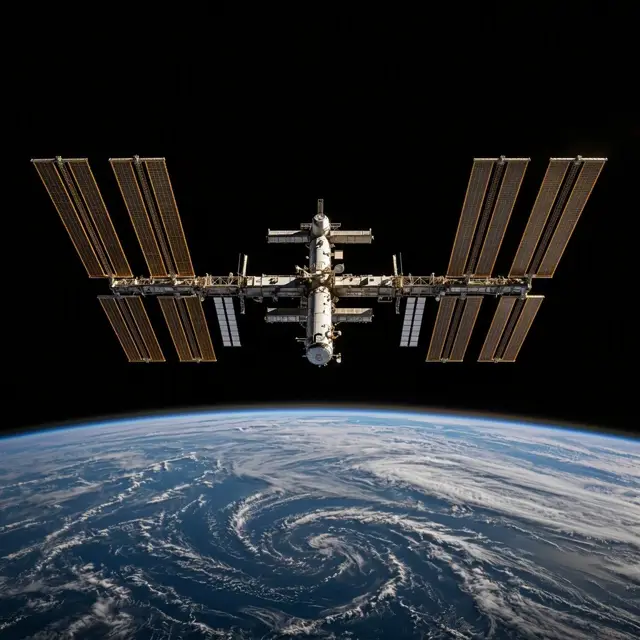
It is also huge. Counting its solar panels, it is about the size of a football field, and the space inside where the crew can breathe is comparable to a Boeing 747 airliner. The living and working area is bigger than a six-bedroom house, with seven private sleeping cabins, three bathrooms, two dining rooms, a gym and a window with a 360-degree view.
When the Sun lights it up, it is the brightest artificial object in the night sky.
Built by Former Rivals
The station started with two old rivals working together. On 20 November 1998, a Russian rocket launched its first piece, a module called Zarya. Two weeks later, the American Space Shuttle Endeavour delivered a second piece, Unity, and joined the two, connecting hardware built on different continents by nations that were once bitter enemies.
Nobody could live on it yet. That changed in July 2000 with the arrival of Zvezda, a module with living quarters and life support. The first crew moved in that November.
Piece by piece, it grew. Russian rockets and the Space Shuttle kept delivering new sections, and astronauts fitted them together using robotic arms or on a spacewalk. By June 2011 they had made over 159 spacewalks, adding up to more than 1,000 hours outside. Building work stopped after the loss of the Space Shuttle Columbia in 2003 and restarted in 2006.
Today the station is made of 43 modules and parts, run by five space agencies from the United States, Russia, Europe, Japan and Canada. It has been called the most politically and legally complicated space program in history.
Daily Life Without Gravity
Here is something surprising: gravity at the station's height is about 90 percent as strong as it is on the ground. Astronauts float because the station is always falling around Earth, a state called microgravity.
That changes everything about daily life. There is no shower. Crews clean themselves with wet wipes or a water jet, using shampoo that needs no rinsing and toothpaste they can swallow. Sleeping bags are tied to the walls, because drifting around while asleep could mean bumping into equipment. Good airflow matters, too: without it, the carbon dioxide you breathe out can build up in a bubble around your head.
Food has its own challenges. Microgravity dulls taste, so meals are seasoned more strongly than on Earth. Drinks come as powder mixed with water and sipped through straws, and stray crumbs must be caught before they clog air filters. Crews have grown lettuce, cabbage and kale on board, and eaten some of it.
Nothing is wasted. The station's water system even turns urine back into drinking water.
Dodging Junk, Then a Planned Fall
The station shares its orbit with a lot of junk: old rocket parts, dead satellites, fragments from explosions and even flakes of paint. Pieces too small to track, from about 1 centimetre down to microscopic size, number in the trillions.
The American modules are protected by a Whipple shield, layers of metal and tough fabric designed to shatter small objects into a cloud before they reach the hull. When tracked debris gets too close, thrusters nudge the station out of the way. If a warning comes too late, the crew closes the hatches and shelters in their spacecraft, ready to leave. That has happened several times, including in November 2021 after a Russian anti-satellite weapon test.
None of this comes cheap. As of 2010, the total cost was estimated at 150 billion US dollars.
Its end is already planned. NASA has chosen SpaceX to build a special vehicle that will guide the station down into a remote area of the South Pacific Ocean known as the spacecraft cemetery.