Eighteen Gold Hexagons
The James Webb Space Telescope (JWST) is a space telescope built for infrared astronomy, and it is the largest telescope in space.
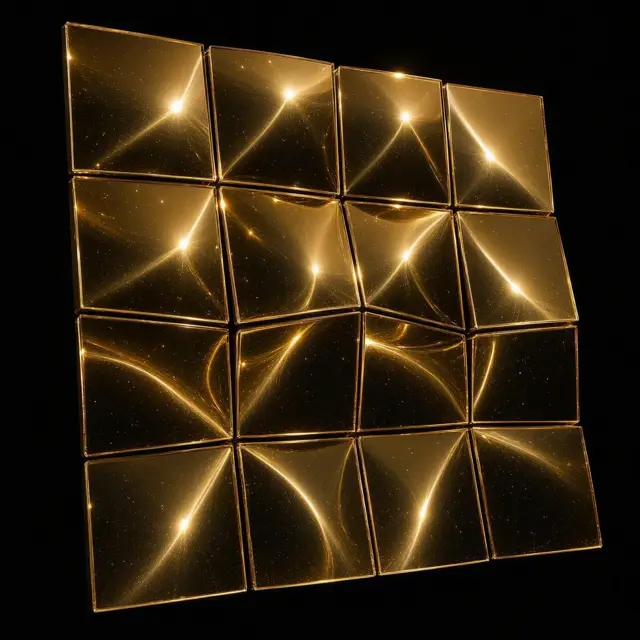
Its primary mirror is not one piece. It consists of 18 hexagonal segments made of gold-plated beryllium, which together form a mirror 6.5 metres across — compared with Hubble's 2.4 m. That gives Webb a light-collecting area of about 25 m², roughly six times Hubble's.
The segmented design exists because no rocket fairing could hold a 6.5-metre mirror in one piece. It had to fold to launch and unfold in space. Webb's high-resolution, high-sensitivity instruments let it view objects too old, distant or faint for Hubble — enabling observation of the first stars and the formation of the first galaxies, and detailed atmospheric characterisation of potentially habitable exoplanets.
Bigger Mirror, Same Sharpness
Here is a counterintuitive fact about Webb. Despite its mirror being 2.7 times larger in diameter than Hubble's, it produces images of comparable resolution.
The reason is what it looks at. Webb observes in the infrared, which has longer wavelengths than Hubble's visible light. And the longer the wavelength a telescope is designed to observe, the larger the collecting surface it needs to achieve the same resolution.
So the enormous mirror does not buy sharper pictures — it buys the ability to see in infrared at all, at the sharpness astronomers expect. Hubble observes from near ultraviolet through near infrared (0.1–2.5 μm); Webb covers a lower frequency range, from long-wavelength red light through mid-infrared (0.6–28.5 μm). Infrared is what lets it see through dust and detect the stretched-out light of the earliest galaxies.
Colder Than Almost Anything
An infrared telescope has a problem no visible-light telescope faces: it glows in the band it is trying to observe. Anything warm emits infrared, including the instrument itself.
The solution is extreme cold. Webb must be kept below 50 K — that is −223 °C — so that its own infrared emission does not swamp the light it collects. A five-layer sunshield protects it from being warmed by the Sun, the Earth and the Moon.
That requirement also dictated where it went. Webb was launched on 25 December 2021 on an Ariane 5 from Kourou, French Guiana, and in January 2022 arrived at a solar orbit near the Sun–Earth L2 Lagrange point, about 1.5 million kilometres from Earth — far enough to keep Sun, Earth and Moon all on one side, behind the shield. Its first image was released publicly on 11 July 2022.
Twenty-Five Years and Ten Billion Dollars
Webb's development is also a case study in how hard this is. Initial designs began in 1996, under the name Next Generation Space Telescope. Two concept studies were commissioned in 1999, aiming at a launch in 2007 on a budget of US$1 billion.
It launched fourteen years late and ten times over budget. The programme saw enormous cost overruns and delays, required a significant redesign in 2005, completed construction in 2016, and then spent years in exhaustive testing — reaching a total cost of US$10 billion.
NASA led the design and development, partnered with the European Space Agency and the Canadian Space Agency. NASA's Goddard Space Flight Center managed development, the Space Telescope Science Institute in Baltimore operates it, and Northrop Grumman was the primary contractor. It is named after James E. Webb, NASA administrator from 1961 to 1968 across the Mercury, Gemini and Apollo programmes.