The Giant of the Solar System
Jupiter is the fifth planet from the Sun and by far the biggest. It is about 11 times wider than Earth, and its mass is 318 times Earth's. That is about two and a half times the mass of all the other planets combined.
It is so heavy that the point Jupiter and the Sun circle around together actually sits just outside the Sun's surface.
Jupiter is a gas giant, made mostly of hydrogen and helium, with no solid surface to stand on. Deep inside, the pressure is so extreme that hydrogen becomes a metal-like fluid. Scientists have even suggested that showers of diamonds may fall inside it.
It spins faster than any other planet, completing a day in slightly less than ten hours. That fast spin makes the planet bulge noticeably around its middle.
It is also slowly shrinking. Jupiter gives off more heat than it receives from the Sun, and as a result it gets about 1 millimetre smaller every year.
A Storm Bigger Than Earth
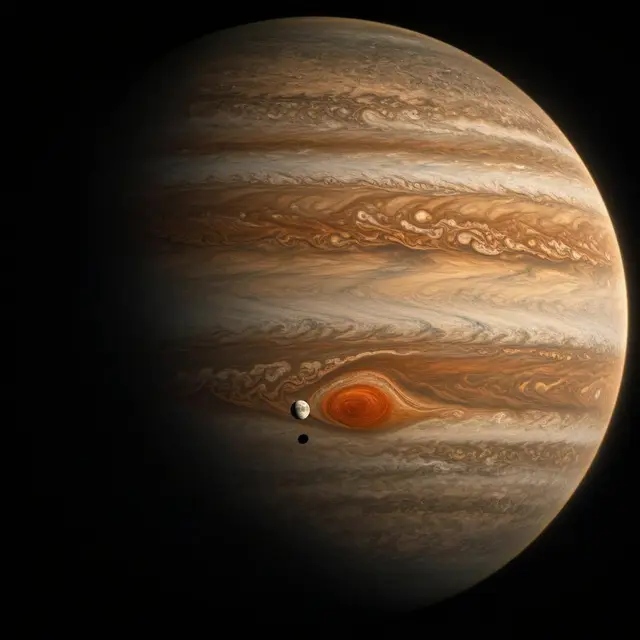
Jupiter's most famous feature is the Great Red Spot, a giant storm just south of its equator. It was first observed in 1831, and possibly as early as 1665.
The storm is larger than the whole Earth and spins around about once every six days. Nobody is completely sure what gives it its red colour.
It is shrinking, though. In the late 1800s, it measured about 41,000 kilometres across. By 2015, it was about 16,500 kilometres long and getting shorter by roughly 930 kilometres a year. In 2021, NASA's Juno spacecraft found that it reaches between 300 and 500 kilometres deep.
Jupiter has other storms too. A smaller storm formed in 2000 when three white oval storms merged, and it later turned red, earning the nickname Little Red Spot. At the planet's poles, Juno found groups of giant storms, each one a cyclone, arranged in neat patterns: nine in the north and seven in the south.
The Solar System's Vacuum Cleaner
Jupiter's powerful gravity has helped shape the whole Solar System. It has been nicknamed the Solar System's vacuum cleaner, because it is hit by more comets and asteroids than any other planet, about 200 times more than Earth.
In July 1994, the world watched as Comet Shoemaker-Levy 9 slammed into Jupiter, observed by telescopes around the world, including the Hubble Space Telescope.
Scientists once believed Jupiter protected Earth by catching dangerous comets. But computer simulations in 2008 suggested it pulls comets inward about as often as it removes them, and scientists still disagree.
Its gravity also holds thousands of Trojan asteroids, which travel in groups ahead of and behind the planet along its orbit. More than two thousand have been found since the first was discovered in 1906.
Jupiter also has the strongest magnetic field of any planet. At times, its radio signals can even be stronger than the radio output of the Sun as seen from Earth.
A Planet With Its Own Mini Solar System
At least 115 moons orbit Jupiter. The four largest, Io, Europa, Ganymede and Callisto, were discovered by Galileo and can be seen with ordinary binoculars. Ganymede is even bigger than the planet Mercury.
Three of these moons move in a perfect rhythm. For every four trips Io makes around Jupiter, Europa makes exactly two and Ganymede makes exactly one. This pattern is known as a Laplace resonance, and it means the moons keep getting stretched and squeezed.
All that squeezing heats them from the inside. That is why Io has so much volcanic activity, and why Europa's icy surface looks so young.
Jupiter even has faint rings, made mostly of dust. Since 2016, NASA's Juno spacecraft has been orbiting the planet, and it sent back the first images ever taken of Jupiter's north pole. When its mission ends, it will be steered into Jupiter's atmosphere so it cannot crash into and contaminate any of the moons.
Jupiter is the third-brightest natural object in the night sky, after the Moon and Venus, and people have watched it since prehistoric times.