A Chain Reaction Above Our Heads
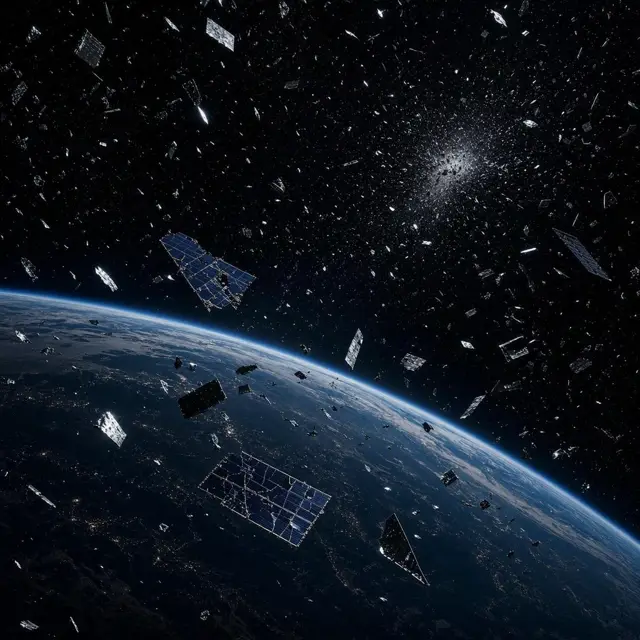
In June 1978, NASA scientists Donald Kessler and Burton Cour-Palais published a paper with an unsettling idea: satellites in low Earth orbit could eventually become their own worst enemy. Every collision between orbiting objects sprays out clouds of fragments — and each fragment becomes a new bullet capable of causing the next collision. Past a critical density, the process feeds itself: debris breeds debris, exponentially, even if we never launch another rocket.
The numbers explain why. Orbital speeds are so extreme that a 1-kilogram object traveling at 10 kilometers per second can catastrophically destroy a 1,000-kilogram spacecraft. The scenario got its name from a NORAD employee, John Gabbard, via a 1982 Popular Science article — the "Kessler syndrome".
Orbit Is Already Crowded
Kessler predicted that by about 2000, human-made debris would overtake natural micrometeoroids as the main impact threat to spacecraft. He was right. As of 2025, roughly 11,800 satellites orbit Earth — 7,135 of them belonging to a single constellation, Starlink — sharing space with an estimated 600,000 debris fragments between 1 and 10 centimeters and 23,000 objects larger than 10 centimeters.
On average, about one satellite is destroyed by collision every year. The first documented crash between two cataloged satellites came in 2009, exactly the kind of event Kessler's model anticipated. Debris at high altitudes can linger for decades or centuries, because there is almost no atmospheric drag to pull it down.
The Explosions That Made It Worse
The worst debris events were self-inflicted. In 1985, a US anti-satellite test destroyed a satellite at 555 kilometers altitude, leaving debris that persisted into the 1990s. In January 2007, China destroyed its FY-1C weather satellite at 865 kilometers — creating fragments that will stay in orbit for decades or centuries. In November 2021, Russia shattered Kosmos 1408, adding 1,500 tracked fragments and hundreds of thousands too small to monitor.
Accidents contribute too: in August 2024, a Chinese Long March 6A rocket stage broke up below 800 kilometers, scattering more than 700 fragments through altitudes crowded with mega-constellations. Each event pushes the debris population closer to the tipping point where cleanup becomes impossible.
Racing the Cascade
Mitigation is now written into international rules: operators must show how satellites will end their lives — through controlled fiery re-entry or by climbing into a distant graveyard orbit, mandatory for US geostationary satellites since 2002. Researchers are developing more aggressive fixes, from the ESA-backed ClearSpace debris-removal missions to a proposed laser broom that would nudge small fragments down into the atmosphere.
How close is the edge? A 2023 economic model put the sustainability threshold near 72,000 satellites. A 2025 analysis warned that a solar storm swelling the atmosphere could shrink the reaction time for avoiding cascading collisions from 121 days to just 2.8. And scientists still cannot agree whether the Kessler syndrome has already quietly begun. Some have even suggested it as an answer to the Fermi paradox: civilizations may trap themselves beneath shells of their own debris. Hollywood took note — the cascade drives the plot of the 2013 film *Gravity*.