A Frozen Doughnut Past Neptune
Out past Neptune lies a zone that makes the asteroid belt look tiny. The Kuiper belt is about 20 times as wide and 20 to 200 times as massive. It stretches from Neptune's orbit, at 30 astronomical units, to about 50 from the Sun. Astronomers think more than 100,000 objects over 100 km wide live there.
Unlike rocky asteroids, most objects here are made largely of ices, such as frozen methane, ammonia and water. That makes sense. The belt sits at only about 50 K, so many things that would be gas near the Sun stay solid. These objects are leftovers from when the Solar System formed.
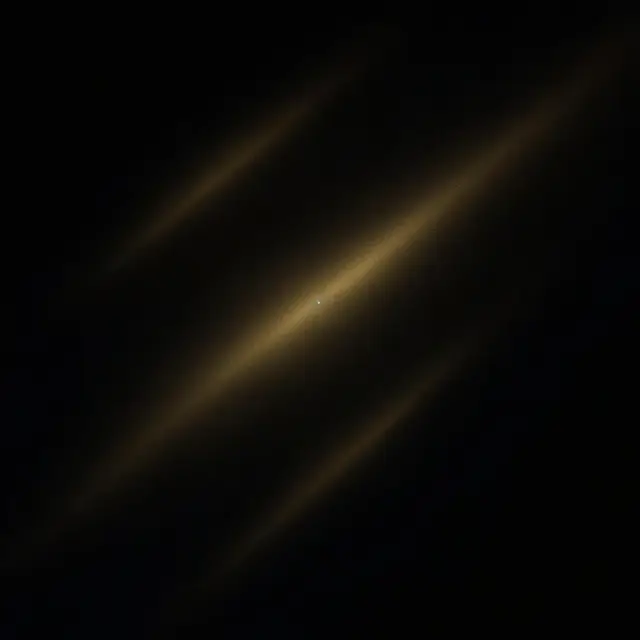
Despite the name, it is not a thin belt. It is quite thick, with objects spread well above and below the flat plane where the planets travel. Overall it looks more like a torus, or doughnut, than a belt. It is also home to most of the accepted dwarf planets, including Pluto, Haumea and Makemake.
Five Years of Blinking at the Sky
In 1987, astronomer David Jewitt was puzzled by how empty the outer Solar System seemed. He asked graduate student Jane Luu to help him hunt for something beyond Pluto. As he told her, "If we don't, nobody will." They searched the same way Pluto had been found, with a blink comparator and pairs of images of the sky.
At first, checking each pair of images took about eight hours. Then came the CCD, an electronic light sensor. It caught 90 percent of the light that hit it, against just 10 percent for photographs. Even better, the blinking could now be done on a computer screen. Today, CCDs form the basis of most astronomical detectors.
After five years of searching, Jewitt and Luu announced their find on 30 August 1992. The object, first called 1992 QB1, was later named Albion. It was the first Kuiper belt object found since Pluto and its moon Charon. By 2018, over 2,000 had been discovered.
How Pluto Lost Its Planet Title
Pluto turned out to have plenty of company. Since 2000, astronomers have found many Kuiper belt objects more than half Pluto's size, in similar orbits. Many have moons, and their surfaces hold methane and carbon monoxide just like Pluto's. The same thing had happened to Ceres, once called a planet before its fellow asteroids were found.
The tipping point was Eris, found in the scattered disc beyond the belt. It is 27 percent more massive than Pluto. This forced the International Astronomical Union to define what a planet is for the first time. A planet must have "cleared the neighbourhood around its orbit". Pluto shares its orbit with many sizable objects, so in 2006 it became a dwarf planet.
Pluto belongs to a family called plutinos. They circle the Sun twice for every three trips Neptune makes, a lockstep pattern known as an orbital resonance. Many plutinos, Pluto included, cross Neptune's orbit, yet their timing means they can never collide with it.
Neptune Rearranged the Neighbourhood
Computer simulations suggest that Uranus and Neptune formed closer to Jupiter. As the giant planets shifted, Neptune was scattered outward into the early belt. Most of the belt objects ended up flung out of the Solar System, cutting the original belt's population by 99 percent or more.
Neptune may even have grabbed a member of the belt. Its large moon Triton is the only large moon in the Solar System with a retrograde orbit, circling the opposite way to Neptune's rotation. That suggests Triton was captured as a fully formed body. It is only 14 percent larger than Pluto, and their surfaces are made of similar materials. Triton was probably once a Kuiper belt object.
There is also a mystery at the edge. Around 50 astronomical units, the number of large objects drops off sharply. This sudden drop, called the Kuiper cliff, still has no known cause. One researcher even suggested an unseen planet the size of Earth or Mars might be responsible.
Snow, Red Worlds and a Distant Flyby
The surfaces out here are full of surprises. Astronomers expected these objects to be uniformly dark. Instead, they range from neutral grey to deep red. Radiation from the Sun is thought to change surface methane into other compounds. On the biggest objects, such as Pluto, gases like nitrogen can boil off the surface and then fall back as snow.
Spotting the small ones takes clever tricks. The tiniest known objects, under 1 km across, are far too dim to see directly. Instead, astronomers catch them during an occultation, when one passes in front of a star. One was found in old Hubble data after it blocked a star for just 0.3 seconds.
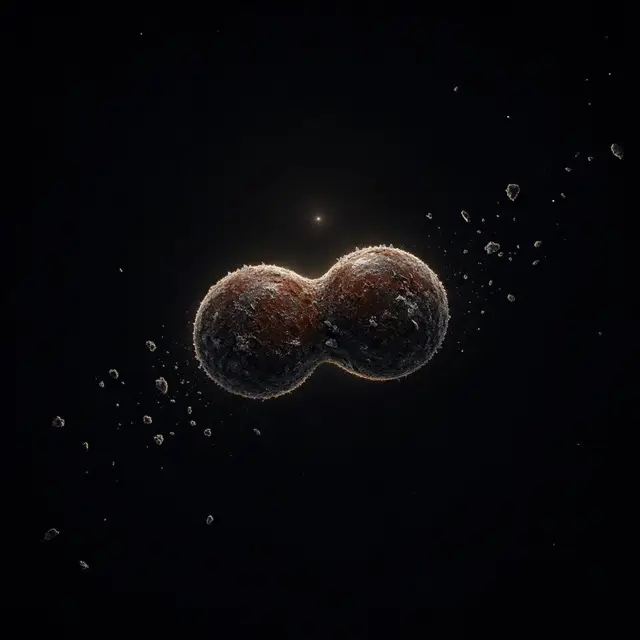
Then came a real visit. NASA's New Horizons launched on 19 January 2006 and flew past Pluto on 14 July 2015. On 1 January 2019, it flew by Arrokoth, a far smaller object. The data showed Arrokoth is a red contact binary, 32 km long and 16 km wide.