Five Parking Spots in Space
Imagine a spot in space where the pull of the Sun and the pull of Earth balance out just right, so a spacecraft can stay in step with Earth while using very little fuel. That spot is real, and there are five of them. They are called Lagrange points.
Each one is a point of equilibrium for a small object caught between two big bodies that orbit each other. There, the gravity of the two large bodies and the outward centrifugal effect of the orbit cancel out. Working out where these points are is part of a classic puzzle known as the three-body problem.
Every pair of orbiting bodies has its own set of five, named L1 to L5. The Sun and Earth have five, and Earth and the Moon have five different ones. L1, L2 and L3 sit on the line through the two big bodies. L4 and L5 each form the tip of an equal-sided triangle with them.
Found With Pen and Paper in the 1700s
These points were found with pen and paper, long before any rocket flew. The Swiss mathematician Leonhard Euler discovered the three points on the line, L1, L2 and L3, around 1750. About a decade later, the Italian-born Joseph-Louis Lagrange discovered the other two, L4 and L5. In 1772 he published an essay on the three-body problem.
Here is how L1 works. Normally, anything orbiting closer to the Sun than Earth finishes a lap sooner than Earth does. But if an object sits directly between Earth and the Sun, Earth's gravity tugs back against the Sun's pull. That makes its lap take longer. At exactly the right distance, the object takes one full year to circle the Sun, just like Earth.
That sweet spot is about 1.5 million kilometres from Earth, toward the Sun. L2 sits the same distance away on the far side of Earth, where Earth's extra pull speeds the lap up instead.
Wobbly Points and Steady Points
Not all five points are equally comfortable. L1, L2 and L3 are unstable, a bit like a ball balanced on top of a hill. Anything parked there tends to fall away. For the Sun and Earth, a satellite at L1 or L2 will wander off within a few months unless it makes course corrections. That is why spacecraft there need a small but critical amount of station keeping.
L4 and L5 are different. They sit 60 degrees ahead of and behind the smaller body in its orbit. They are stable as long as the bigger body is more than 24.96 times as heavy as the smaller one. The Sun and Earth pass this test, and so do the Sun and Jupiter. The Earth and Moon pass it by a smaller margin.
When something at L4 or L5 gets nudged, it does not fly away. Instead it loops around the point in a stable path shaped like a kidney bean.
A Million Asteroids Along for the Ride
Because L4 and L5 are stable, nature fills them up. Objects found there are called trojans. Jupiter has more than one million trojans sharing its path around the Sun, split into a group ahead of it and a group behind.
Earth has company too. The Sun-Earth L4 and L5 points hold dust and at least two asteroids, 2010 TK7 and 2020 XL5. Mars has four accepted trojans, and Neptune has several dozen. Around Saturn, one of its moons has two tiny moons riding in its own L4 and L5 points.
One version of the giant impact idea goes even further. It suggests that a body formed at the Sun-Earth L4 or L5 point, drifted out of place and crashed into Earth, forming the Moon. Meanwhile, L3, hidden behind the Sun, was once a favorite spot for a secret Counter-Earth in pulp science fiction. Science had ruled that out long before the Space Age.
Where the Webb Telescope Lives
Lagrange points have become prime real estate for spacecraft. At Sun-Earth L1, a satellite is never in Earth's shadow and always sees the sunlit side of our planet. The DSCOVR satellite has orbited there since June 2015, studying the solar wind and taking pictures of Earth. Space weather from the Sun reaches L1 up to an hour before it hits Earth.
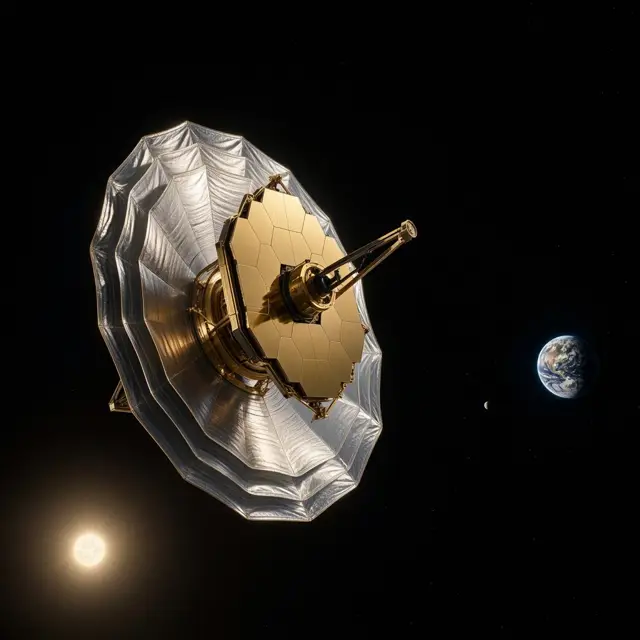
L2, on the far side of Earth, is a favorite spot for space telescopes. From there, the Sun, Earth and Moon all sit close together in the sky, so one sunshield can block all three. The James Webb Space Telescope settled into a halo orbit around L2 on 24 January 2022, and its shaded side can cool to around 50 kelvin. The Nancy Grace Roman Space Telescope launched toward L2 on 30 August 2026.
The Moon's points are useful as well. The Queqiao satellite, launched in 2018, used Earth-Moon L2 to cover the Moon's far side.