A Day Twice as Long as a Year
On Mercury, waiting from one sunrise to the next takes about 176 Earth days. That is twice as long as the planet's year, which lasts just 88 Earth days. So one side of Mercury stays in sunlight for a whole Mercury year, then sits in darkness for the next one.
This odd timing comes from a spin-orbit resonance. Mercury spins three times for every two trips around the Sun. For many years, astronomers thought Mercury always kept the same face toward the Sun, the way the Moon always shows the same side to Earth. Radar observations in 1965 proved that idea wrong.
The old mistake had a simple cause. Whenever Mercury was best placed for viewing from Earth, it happened to show nearly the same face. Stranger still, from some spots on Mercury the Sun would rise partway, then reverse and set, then rise again, all within the same Mercury day.
Scorching Days and Icy Craters
Mercury is the smallest planet in the Solar System and the closest one to the Sun. Yet it is not the hottest. That title goes to Venus, because Mercury has no real atmosphere to trap heat. Near Mercury's equator, temperatures swing from about minus 170 °C at night to 420 °C in sunlight.
Instead of a proper atmosphere, Mercury has a very thin exosphere. It holds hydrogen, helium, oxygen, sodium, potassium and other elements. It is not stable: it keeps losing atoms and gaining new ones. Some come from the solar wind, and some are knocked off surface rock by tiny meteorite impacts.
Mercury's axis is almost perfectly upright, tilted only about 0.027 degrees. Because of this, the floors of deep craters near the poles never see direct sunlight and stay far colder than the rest of the planet. Radar hinted at ice there in the early 1990s, and images from the MESSENGER probe confirmed water ice near the north pole.
A Giant Iron Heart
Mercury is small but very heavy for its size. Its density is the second highest in the Solar System, only slightly below Earth's. Scientists reason that for such a small planet to be that dense, its core must be large and rich in iron.
And it is. The core takes up about 57% of Mercury's volume, compared with 17% for Earth, and it holds more iron than any other planet's core. One idea is that a large body struck the young planet and stripped away much of its outer rock. Another says the early Sun's heat turned surface rock into vapour. Yet MESSENGER found more potassium and sulfur than expected, which argues against both ideas.
That iron core likely powers a global magnetic field, about 1.1% as strong as Earth's. Its discovery by Mariner 10 was a big surprise, because Mercury was thought to spin too slowly to make one. In 2008, MESSENGER found magnetic "tornadoes" up to 800 kilometres wide that let the solar wind reach the surface.
Craters Named After Artists
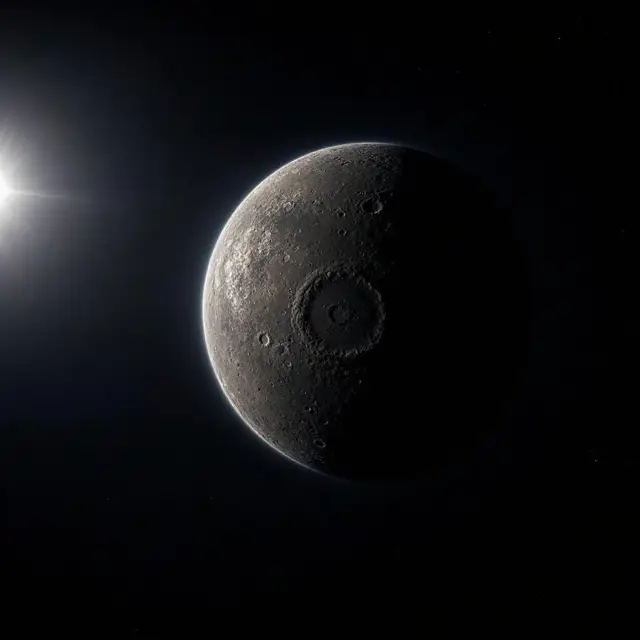
Mercury's surface looks a lot like our Moon's, covered in craters. With no atmosphere to slow them down, comets and asteroids struck the whole planet early in its history. The largest crater, Caloris Planitia, is 1,550 kilometres across, about one-third of the planet's own width.
The Caloris impact was so powerful that it caused lava eruptions and left a ring of mountains about 2 kilometres tall. On the exact opposite side of the planet lies a patch of odd, hilly land known as the "Weird Terrain". One idea is that shock waves from the impact raced around Mercury and met there, cracking the surface.
Crater names follow a fun rule. The International Astronomical Union requires each new crater to be named after an artist who was famous for more than fifty years and dead for more than three. Mercury also has giant scarps, which are thought to have formed as the planet shrank slightly while its iron core cooled.
Hard to See, Hard to Reach
Mercury never strays far from the Sun in our sky, so it is lost in the glare much of the time. It shows up only briefly in morning or evening twilight. The Hubble Space Telescope cannot observe it at all, because safety rules stop it from pointing so close to the Sun.
Getting there is hard too. Mercury needs the highest delta-v of any planet for a trip from Earth. In 1974, Mariner 10 made the first successful flyby, using the gravity of Venus as a slingshot. MESSENGER entered orbit in 2011 and ended its mission in 2015 by crashing into the surface, leaving a crater about 16 metres wide.
Mercury also helped test big ideas. Its orbit slowly shifts in a way that Newton's laws could not fully explain. Astronomers even proposed a hidden planet called Vulcan to account for it, but no such planet was ever found. Einstein's general theory of relativity finally explained the shift in the early 20th century. Next up is BepiColombo, a European and Japanese mission launched in 2018 and due to enter orbit in 2026.