Comet Crumbs at Blazing Speed
A meteor shower happens when Earth passes through a stream of debris left by a comet, or sometimes an asteroid. These bits, called meteoroids, hit the atmosphere at very high speeds on parallel paths. Most are smaller than a grain of sand, so almost all of them break apart and never reach the ground.
A typical shower meteor is only about 5 micrometres across. Speeds vary a lot. Taurid meteors arrive at about 27 km per second, while Leonids hit at about 71 km per second. They light up at heights of about 70 to 110 km, where the air is thick enough to heat them, and they start to melt at around 1800 K.
Each time a comet swings past the Sun, some of its ice turns to vapour and drags dust, sand and pebbles away. That material spreads along the comet's whole orbit, forming a dust trail. In 1951, Fred Whipple described comets as dirty snowballs, made of rock embedded in ice.
From Lightning Lumps to Space Dust
People recorded meteor showers long before anyone understood them. Records suggest observations in Sparta as early as 1200 BCE. Chinese records of the Lyrids go back to 687 BCE, making them the oldest shower recorded continuously. A shower in August 1583 was even written down in the Timbuktu manuscripts.
Explaining them took longer. In 1789, the chemist Antoine Lavoisier guessed that lightning pressed dust in the upper air into lumps that fell as fiery meteors. In 1794, Ernst Chladni proposed that they came from outer space instead. Many scientists doubted him, because the idea clashed with Isaac Newton's statement that space must be empty.
The great Leonid storm of 1833 helped settle things. Denison Olmsted noticed that the meteors seemed to come from one spot in the constellation Leo, and he guessed they came from a cloud of particles in space. In 1866, Giovanni Schiaparelli showed that the Leonids share an orbit with Comet Tempel.
Why They All Seem to Come From One Spot
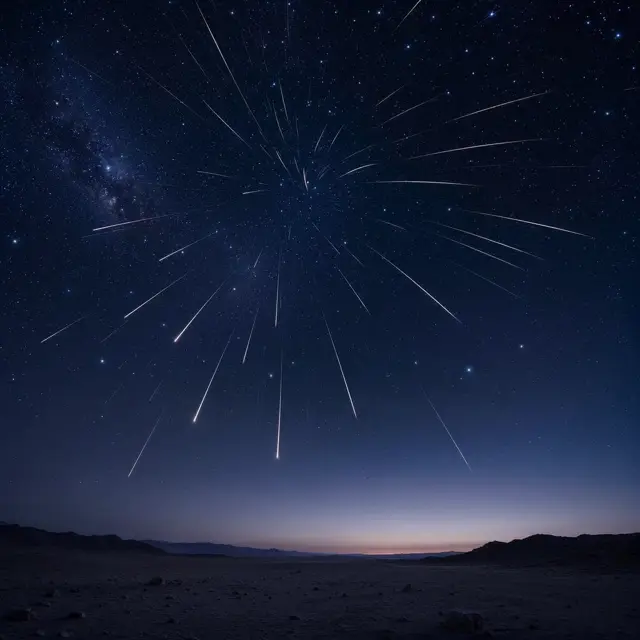
Shower meteors travel on parallel paths at the same speed, so from the ground they appear to burst out of a single point, the radiant. It is a trick of perspective, like railway tracks meeting at one point on the horizon. Showers are usually named after the constellation where the radiant sits. Meteors from near the star Delta Aquarii, for example, are called the Delta Aquariids.
Timing matters. Most showers get better after midnight, when your side of Earth faces the direction Earth is moving around the Sun. The best time is usually just before dawn, a balance between seeing the most meteors and a sky that is starting to brighten.
Where you look matters too. Viewing is best when the radiant is about halfway up the sky, at 45 degrees. The longer, more striking trails then show up 30 to 60 degrees away from it. The radiant also drifts slowly across the sky during the night as Earth turns.
Meteor Storms: Thousands an Hour
A meteor storm brings at least 1,000 meteors an hour, ten times the busiest normal showers. The Leonids are the best-known source. During the November 1833 storm, one estimate put the peak at over 100,000 meteors an hour, and another counted more than 200,000 over nine hours across eastern North America.
Storms have been described as looking like stars falling from the sky, or even fireworks. Leonid storms come roughly every 33 years, when Comet Tempel-Tuttle returns. Astronomers do not expect the next one until around 2034 or even 2099.
The planets play a part, much like a gardener aiming a hose at a distant plant. Their gravity decides where a dust trail crosses Earth's orbit, so most years the trail misses us, and in others we get showered. In normal years, the Perseids are the most reliable, peaking on 12 August at more than one meteor a minute. One astronomer has even predicted a possible Perseid storm in August 2028.
Meteor Showers on Other Worlds
Earth is not the only place with meteor showers. Any world with a fairly clear atmosphere can have them, and Mars is known to. On 7 March 2004, a camera on the Mars rover Spirit recorded a streak now believed to be a meteor from a Martian shower linked to comet 114P/Wiseman-Skiff.
At ground level, Martian air is less than one percent as dense as Earth's. But high up, where meteoroids strike, the two are more alike, so Martian meteors look much the same. They move a little slower because Mars is farther from the Sun, which should make them slightly dimmer. On the other hand, the slower fall gives them more time to burn away.
The Moon catches the same showers as Earth, but without a real atmosphere the effects are different. NASA keeps a database of impacts seen on the Moon. Meteors have also been discussed for Mercury, Venus, Saturn's moon Titan, Neptune's moon Triton and Pluto.