A Rock From Space on Your Bed
In October 2021 a meteorite broke through the roof of a house in Golden, British Columbia, and landed on a bed. In July 2024 a security camera on Prince Edward Island, Canada, caught another one crashing into a home. It is believed to be the first time such an event was filmed with its sound recorded.
A meteorite is a rock from space that survives the trip down to a planet or moon. On the way in, it heats up and glows as a meteor, or shooting star. Astronomers call the brightest ones bolides. Most meteoroids break apart in the air, and only five to ten falls a year are seen and then recovered.
Scientists sort them into two groups. A "fall" is one that people or cameras saw arrive. Everything else is a "find." As of January 2019, the main database had 1,180 confirmed falls.
Thumbprints, Crusts and Fireballs
A falling meteorite can put on a show. Its fireball may rival the sun in brightness and has been seen in yellow, green and red. People have heard booms and rumbles as far as a hundred kilometers or more away. Odd whistling and hissing sounds are sometimes reported too, and nobody fully understands them.
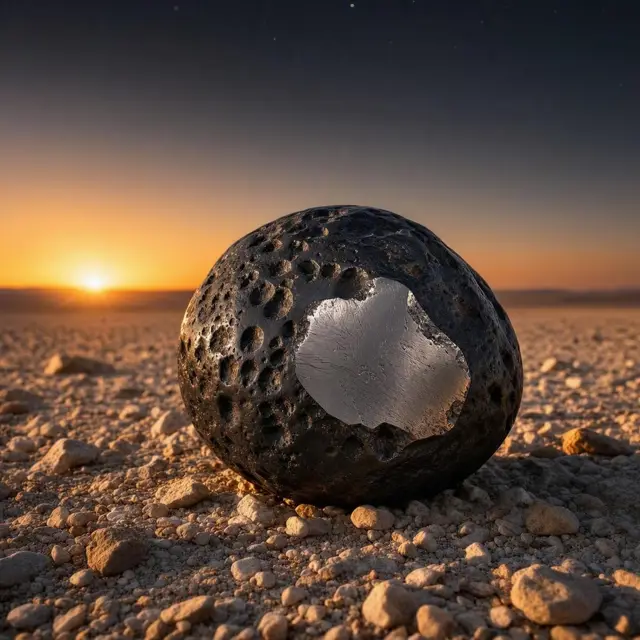
The trip leaves marks. As the surface melts away, it can get shallow dents that look like thumbprints, called regmaglypts. As the rock slows down, its melted skin hardens into a thin, usually black fusion crust. Some meteorites were reported "burning hot to the touch" when they landed, while others were said to be cold enough to form frost.
When a meteoroid breaks up, it can drop anywhere from a few to thousands of pieces. They scatter over an oval area called a strewn field, and the biggest pieces usually land farthest along the flight path.
The Oldest Things You Can Hold
Most meteorites date from the early Solar System. That makes them by far the oldest material found on Earth. About 86% are chondrites, named after the tiny round grains inside them. Chondrites are typically about 4.55 billion years old and are often called "the building blocks of the planets."
Iron meteorites are rarer, but they are easy to tell apart from ordinary rocks, so people tend to notice them. Most are thought to come from the molten cores of early small worlds that later broke apart in collisions. A few meteorites come from the Moon, and one group almost certainly comes from Mars. They are the only materials from other planets that humans have ever recovered.
Some meteorites even carry ingredients linked to life. In 2019 scientists reported finding sugars, including ribose, in meteorites for the first time. In 2022 a Japanese group reported all five bases of DNA and RNA inside carbon-rich meteorites.
Where the Hunters Look
Meteorites fall with nearly equal odds everywhere on Earth. The hard part is spotting them. Harvey H. Nininger showed they are far more common on the ground than people had thought. From the late 1920s to the 1950s he traveled across the Great Plains of the United States, teaching local people what to look for. More than 200 new meteorites turned up.
Antarctica turned out to be a treasure chest. In 1969 a Japanese expedition found nine meteorites on a blue ice field. Moving ice, it turned out, can gather meteorites in certain spots. Since 1974, searches there have produced more than 23,000 classified specimens.
Hot deserts work too, because dark rocks are easy to see on flat, pale, pebbly ground. Thousands have come from the Sahara and Northwest Africa. The gravel plains of Oman had yielded about 5,000 by mid-2009, including many from the Moon and Mars.
From Ancient Beads to a Change of Mind
People used meteorites long before they understood them. The oldest known iron objects are nine small beads hammered from meteorite iron. They were found in northern Egypt and date to 3200 BC.
For a long time, scientists doubted that rocks could fall from space. In 1794 the German physicist Ernst Florens Chladni argued that meteorites came from outer space, and he was met with resistance and mockery. Then, on 26 April 1803, thousands of meteorites fell on L'Aigle, France. The French scientist Jean-Baptiste Biot studied the fall, and within about ten years of Chladni's booklet the idea was widely accepted.
Much earlier, in 1064, Shen Kuo in China recorded a loud noise like thunder and "a giant star, almost like the moon." He later found the crater with the still-hot meteorite inside. Today, meteorites are named after the place where they were found, usually a nearby town.