The Side You Will Never See
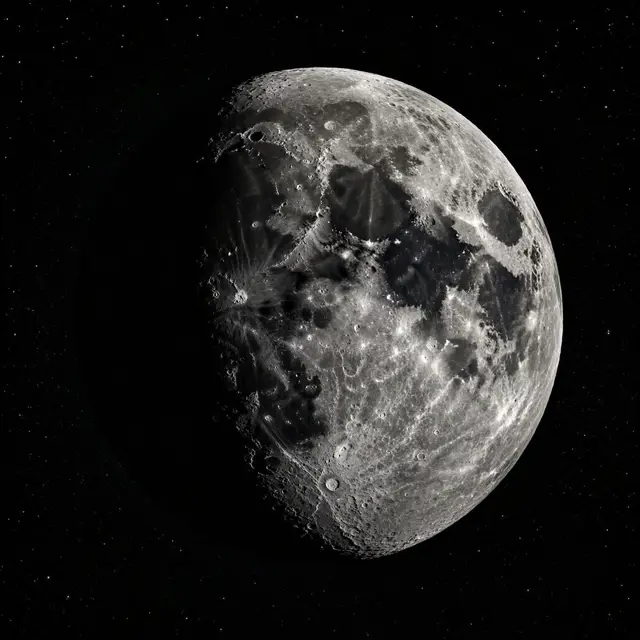
The Moon is tidally locked to Earth. Its rotation period exactly matches its orbital period, a 1:1 spin and orbit resonance called synchronous rotation, so it keeps nearly the same face turned toward us forever. The half pointed at us is the near side, the other is the far side.
Calling the far side the "dark side" is simply wrong. It is illuminated exactly as often as the near side, once every 29.5 Earth days. It is hidden, not dark.
The lock is not perfect, which is a small mercy. Because the Moon's orbit is slightly elliptical and tilted, it appears to rock and nod very slightly from our point of view, an effect called libration. Over time and from different places on Earth, that wobble reveals about 59% of the Moon's surface rather than a flat 50%. On occasion you can glimpse up to about 101% of a full moon's worth, sneaking a look around the edge.
It Is Mostly Made of Us
Isotope dating of lunar samples suggests the Moon formed around 50 million years after the origin of the Solar System. The prevailing explanation is violent: a giant impact between the proto-Earth and a Mars-sized body named Theia, about 4.51 billion years ago.
The oblique collision blasted material into orbit, which then accreted just beyond Earth's Roche limit and became the Moon. The impact released enough energy to liquefy both the ejected material and Earth's crust, forming a magma ocean, and the newly formed Moon had a magma ocean of its own, estimated at somewhere between 500 and 1,737 km deep.
The strongest evidence is chemical. Mars and Vesta have very different oxygen and tungsten isotope compositions from Earth, but Earth and the Moon are nearly identical, which is hard to explain unless they share material. Every rival theory fails somewhere: fission would need an impossibly fast-spinning Earth, capture would need an absurdly extended atmosphere, and co-formation cannot explain why the Moon is so short of metals.
Why the Sea Moves
Earth and the Moon are bound by gravity that pulls harder on the sides facing each other. The resulting tidal forces are the main driver of Earth's tides, and they are the same forces that dragged the Moon into always showing us one face.
The relationship is genuinely mutual, which is not how it is usually pictured. Earth and the Moon share a centre of mass called the barycenter, and it sits about 5,000 km from Earth's centre, roughly three quarters of the way out from the middle to the surface. Both bodies orbit that point, so Earth wobbles around it once for every orbit the Moon makes.
That arrangement is slowly unwinding. Tidal friction constantly drains energy from the rotating pair, pushing the barycenter outward, and eventually it will lie outside the Earth entirely. The Moon's crust feels the same forces in reverse, flexing through tides of around 10 cm over 27 days.
The Coincidence That Gives Us Eclipses
The Moon's apparent size in our sky is about the same as the Sun's. Nothing requires that. It is the reason a total solar eclipse works at all, with the Moon covering the Sun almost exactly.
It is not a fixed match, because the orbit is elliptical. The distance ranges from about 356,400 km at perigee to 406,700 km at apogee, which makes the Moon's apparent size fluctuate by up to 14%.
Another mismatch between reputation and reality is brightness. The Moon is the brightest object in Earth's night sky, but only because it is large and close. The reflectance of its surface is comparable to that of asphalt. It looks bright the way a road looks bright under a streetlight. The favour is returned at night: Earthshine makes the lunar near side about 43 times brighter, and sometimes 55 times brighter, than an Earth night lit by a full moon.
The Only Place We Have Stood
The Moon is the only celestial body beyond Earth that humans have visited, and the first target of every kind of spaceflight milestone.
The sequence began in 1959 with the Soviet Luna 1 flyby and the deliberate impact of Luna 2, followed in 1966 by the first soft landing with Luna 9 and the first orbital insertion with Luna 10. Humans reached lunar orbit with Apollo 8 on 24 December 1968, and the surface with Apollo 11 on 20 July 1969.
By 1972, six Apollo missions had landed twelve people, staying up to three days at a time. Then it stopped for decades. Renewed robotic exploration, particularly work confirming the presence of water on the Moon, has driven plans to return, with the Artemis programme of the 2020s including a crewed flyby with Artemis II in 2026.