The Planet Found by Maths First
Neptune holds an odd record. It is the only planet in the Solar System that was not first found by simply looking at the sky. It was found with maths.
The clue came from Uranus. In 1821, Alexis Bouvard published tables of Uranus's orbit. Later observations did not match them. Bouvard suspected that an unknown body was pulling on Uranus through gravity, a kind of perturbation. After his death, two mathematicians worked out where this hidden planet should be, each on his own: John Couch Adams and Urbain Le Verrier.
Le Verrier wrote to Johann Gottfried Galle at the Berlin Observatory. A student there, Heinrich d'Arrest, suggested comparing a recent chart of the sky with the real sky to spot anything that had moved. On 23 September 1846, the very day the letter arrived, Galle found Neptune. It sat just 1 degree from where Le Verrier said it would be. Adams's estimate was about 12 degrees off.
Galileo Saw It and Missed It
Neptune had been seen long before 1846. Galileo's drawings from 28 December 1612 and 27 January 1613 include points that match Neptune's position on those dates. He seems to have mistaken it for a fixed star. At the time, Neptune was barely moving across the sky, so its motion was far too slight for his small telescope to show.
In England, James Challis also spotted Neptune twice in August 1845, a year before Galle. His out-of-date star maps and poor observing methods meant he did not realise it. He later blamed his maps and his work on comets.
After the discovery, the French and the British argued over who deserved the credit. In the end, Le Verrier and Adams shared it. The name caused a fight too. Le Verrier first proposed Neptune, then tried to name the planet after himself. That met stiff resistance outside France, and Neptune became the accepted name.
The Windiest Planet
Neptune has the strongest steady winds of any planet in the Solar System, reaching as high as 2,100 km/h. Strangely, most of its winds blow in the opposite direction to the planet's spin.
That is surprising for a world so far from the Sun. Neptune gets only about 40% of the sunlight that Uranus receives. Its cloud tops are one of the coldest places in the Solar System, near minus 218 °C. Yet Neptune gives off about 2.61 times as much energy as it takes in from the Sun. Scientists do not know the source of this inner heat, but it is enough to power the fastest winds of any planet.
When Voyager 2 flew past in 1989, it saw a huge anticyclonic storm called the Great Dark Spot, about 13,000 by 6,600 kilometres. About five years later, the Hubble Space Telescope looked again and the spot was gone. A new storm had appeared in the northern hemisphere instead.
Diamond Rain in a Hot, Deep Interior
Neptune has no solid surface. It is mostly gases and liquids, and scientists group it with Uranus as an ice giant. It has 17 times the mass of Earth and is nearly four times as wide.
The word ice is a bit misleading. Beneath the atmosphere lies the mantle, a hot, dense fluid rich in water, ammonia and methane. It weighs as much as 10 to 15 Earths. Deep inside, things get even stranger. About 7,000 kilometres down, conditions may break methane apart into diamond crystals that rain down like hailstones. High-pressure lab experiments suggest the top of the mantle may even be an ocean of liquid carbon with floating solid diamonds.
At the centre sits a core likely made of iron, nickel and silicates. The pressure there is about twice that at the centre of Earth. The temperature may reach 5,400 K, or about 5,100 °C.
One Brief Visit From Voyager 2
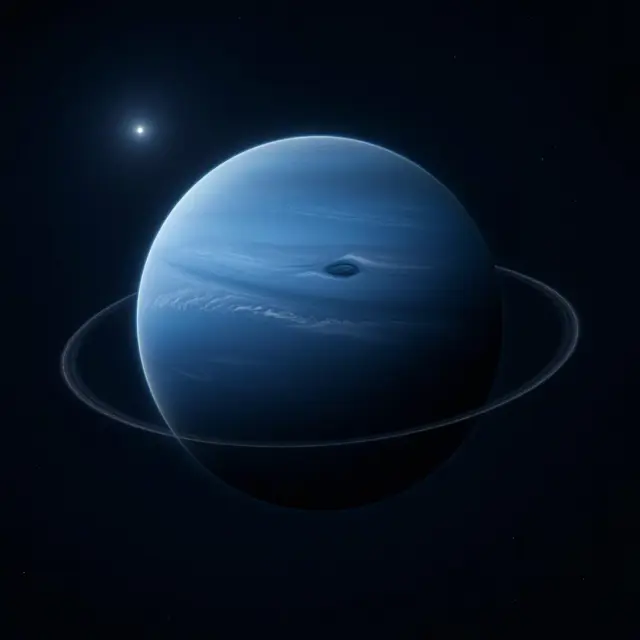
Only one spacecraft has ever visited Neptune. Voyager 2 made its closest approach on 25 August 1989, coming within 4,400 kilometres of the planet's atmosphere. Its signals took 246 minutes to reach Earth, so the mission mostly ran on commands planned in advance. It found six new moons and showed that Neptune has more than one ring.
Voyager's images also created a myth. They boosted the colour contrast to show clouds, bands and winds, making Neptune look deep blue. In truth, it is only faintly blue, just a little richer than Uranus.
Neptune's biggest moon, Triton, is odd too. It travels in a retrograde orbit, which suggests it was captured rather than formed in place. It is slowly spiralling inward and will be torn apart in about 28 billion years. Meanwhile, Neptune takes 164.8 years to circle the Sun. It finished its first full orbit since its discovery only in 2011.