A Matchbox Weighing 3 Billion Tonnes
Fill an ordinary matchbox with material from a neutron star and it would weigh about 3 billion tonnes. That is as much as a chunk of Earth half a cubic kilometer in size. A single teaspoon would have a mass of more than 5.5 trillion kilograms.
A neutron star is the collapsed core of a massive star. It packs about 1.4 times the mass of the Sun into a ball with a radius of roughly 10 kilometers. Only black holes are smaller and denser. If you squeezed the whole Earth to the same density, it would fit inside a sphere just 305 meters across.
Writers sometimes describe neutron stars as giant atomic nuclei, since their density is close to that of a nucleus. The big difference is what holds them together. A nucleus is bound by the strong nuclear force, while a neutron star is held together by gravity. There may be around one billion of them in the Milky Way.
Born When a Giant Star Collapses
Any star born with more than eight times the mass of the Sun could end up as a neutron star. Late in its life, such a star builds up a core rich in iron. When the core runs out of nuclear fuel, it can no longer hold itself up, and it collapses. Temperatures soar past 5 billion kelvins.
Under that crushing pressure, electrons and protons merge into neutrons, releasing a flood of tiny particles called neutrinos. The collapse stops only when the core reaches the density of an atomic nucleus. The outer layers of the star are then flung outward in a supernova, leaving the neutron star behind.
Mass decides the ending. If the leftover core is heavier than about three times the Sun, it keeps collapsing into a black hole. The heaviest neutron star found so far, PSR J0952-0607, is about 2.35 times the mass of the Sun. A newborn neutron star is also incredibly hot, with a surface of ten million kelvins or more, and then it slowly cools.
Spinning 716 Times a Second
When a star's core collapses, it keeps its spin but shrinks to a tiny fraction of its size, so it spins far faster. This is conservation of angular momentum at work. A newborn neutron star can spin several hundred times a second. The fastest known, PSR J1748-2446ad, turns 716 times a second, so its surface moves at nearly a quarter of the speed of light.
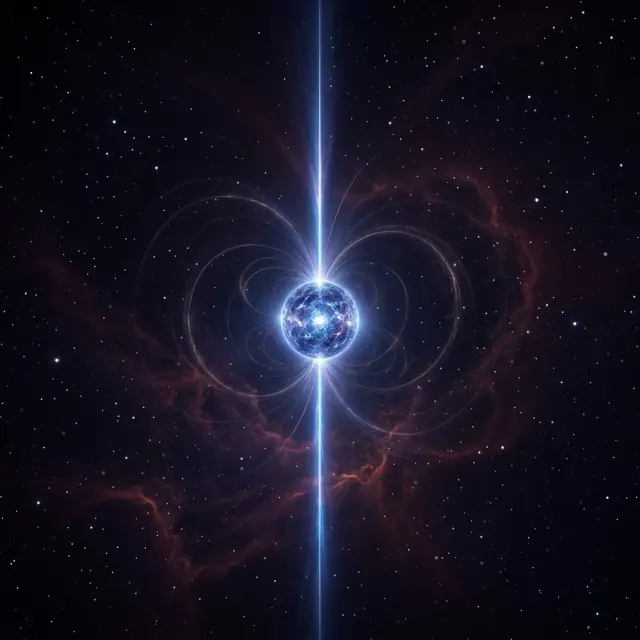
Some neutron stars send out beams of radiation from their magnetic poles. If a beam sweeps past Earth as the star turns, we see regular pulses, and the star is called a pulsar. In 1967, Jocelyn Bell Burnell and Antony Hewish detected such pulses, the first real sign that neutron stars exist. Before 1968, many scientists thought pulsars were pulsating white dwarfs.
Over time, neutron stars slow down, and old ones may take several seconds per turn. But sometimes one suddenly speeds up a little. This is called a glitch. One idea is that it comes from a starquake, when the stiff crust cracks and the star becomes slightly rounder.
Gravity Strong Enough to Slow Time
Gravity on a neutron star is about 200 billion times stronger than on Earth. Drop an object from just 1 meter above the surface and it would hit the ground at around 1,400 km per second. To escape, something would need to travel at more than half the speed of light.
This gravity bends light so much that parts of the star's back side become visible. It also slows time. While eight years pass on the surface of a neutron star, ten years would pass on Earth. This effect is called time dilation. The same gravity keeps the crust extremely hard and smooth, with bumps of millimeters or less.
The magnetic fields are wild too. In a lab, a 16 tesla field can make a living frog float. Neutron star fields range from about 10,000 to 100 billion teslas. A neutron star with one of the very strongest fields is called a magnetar. Its field is so intense that atoms are forced into thin cylinders and the crust can crack.
When Two Neutron Stars Collide
Sometimes two neutron stars orbit each other. As they give off gravitational waves, they spiral closer until they finally merge. In August 2017, the LIGO and Virgo detectors caught these waves from such a merger, called GW170817. About 70 observatories watched the same event across the electromagnetic spectrum.
The collision produced a kilonova, a burst of light from radioactive material thrown out in the merger. Crashes like this create so many neutrons that they may be responsible for around half of the forms of chemical elements heavier than iron.
Neutron stars can even host planets. In fact, the first planets ever found outside our solar system were three worlds orbiting a pulsar, discovered between 1992 and 1994. The smallest of them has just twice the mass of the Moon, making it the smallest exoplanet ever detected. Life there would be tough, though. Pulsar planets get little visible light but huge amounts of harsh radiation.