A Ghost With a Long Family History
Hunting invisible planets is an old tradition. After Neptune was found in 1846, astronomers kept looking farther out. In 1906, Percival Lowell launched his famous search for "Planet X" — a hunt that led to Clyde Tombaugh's discovery of Pluto in 1930. There was just one problem: Pluto turned out to be far too small to be the world Lowell's calculations demanded.
The modern mystery began in 2003 with the discovery of Sedna, a distant icy body whose orbit never comes anywhere near Neptune — something known planets struggle to explain. When a second such object, 2012 VP113, appeared in 2014, astronomers noticed the distant orbits were strangely aligned, and an old question returned: is something big out there?
Six Orbits, One Suspicion
In early 2016, Caltech astronomers Konstantin Batygin and Michael Brown published the case that turned speculation into a serious hypothesis. Six extreme trans-Neptunian objects — bodies orbiting far beyond Neptune — had orbits tilted and pointed in eerily similar directions. The chance of that alignment being random: just 0.007%.
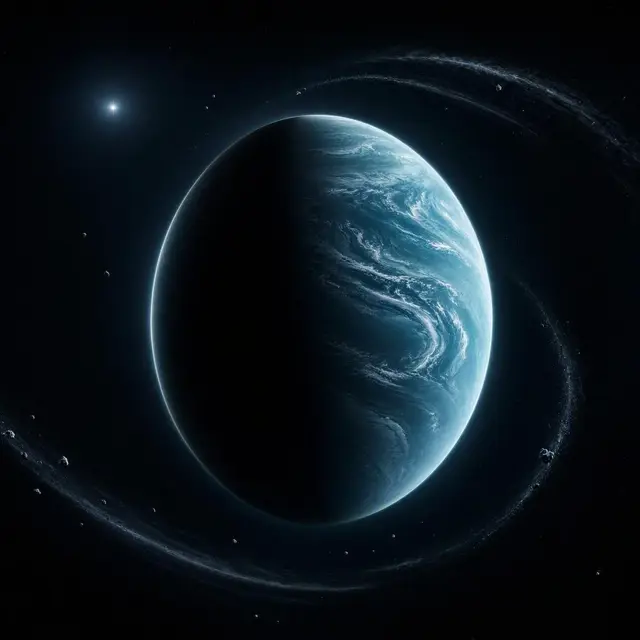
Their proposed shepherd was a planet of five to ten Earth masses on an enormous elliptical orbit hundreds of astronomical units away, taking 10,000 to 20,000 years per lap around the Sun. Refinements have since shrunk the ghost: a 2021 update suggested about 6.2 Earth masses, and a 2025 analysis pointed to roughly 4.4 Earth masses orbiting near 290 astronomical units, circling once every ~4,940 years. Brown once put his confidence in the planet's existence at 90%.
How Do You Lose a Planet?
If Planet Nine exists, why hasn't anyone seen it? Distance is merciless: at hundreds of astronomical units, even a super-Earth reflects almost no sunlight, glowing near apparent magnitude 21 — at the edge of what many surveys can detect, with an unknown position along a vast orbit. Surveys like WISE and Pan-STARRS could not rule it out, and the 8-meter Subaru Telescope continues the hunt. Many astronomers expect the Vera C. Rubin Observatory's decade-long sky survey to settle the question.
Its origin story is equally uncertain. It may be a core ejected outward by Jupiter or Saturn during the Solar System's chaotic youth, a planet stolen from a passing star, or — most exotically — some researchers proposed in 2019 that the gravitational culprit might not be a planet at all, but a primordial black hole the size of a fruit.
Or Maybe It Was Never There
The hypothesis has serious critics. Later surveys — OSSOS and the Dark Energy Survey — found hundreds of new trans-Neptunian objects, and when corrected for where telescopes happened to look, the famous clustering weakened. Astronomer Samantha Lawler argued the original signal was an artifact of a small sample. Alternative explanations exist too: a massive disk of icy debris whose collective gravity aligns orbits could mimic a single planet.
Recent discoveries cut both ways. The sednoid 2023 KQ14, found in 2025, fills a gap in the orbital pattern — but sits where Planet Nine's gravity should have destabilized it, suggesting any hidden planet must orbit farther out than predicted. Batygin himself stays honest about the stakes: until Planet Nine is caught on camera, he says, it does not count as real — all we have now is an echo.