The Signal They Nicknamed Little Green Men
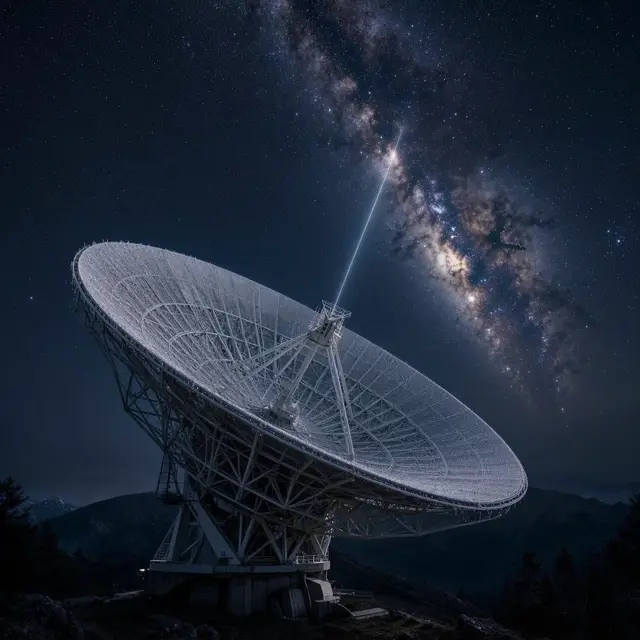
Jocelyn Bell was working through data recorded on 6 August 1967 from a radio telescope she had helped build. Her supervisor, Antony Hewish, initially dismissed the odd signal as radio interference.
It would not go away, and it kept appearing at exactly the same declination and right ascension, which ruled out anything on Earth. On 28 November 1967, using a fast strip chart recorder, Bell and Hewish resolved it into a series of pulses spaced evenly every 1.337 seconds. Nothing like it had ever been observed.
They nicknamed the source LGM-1, for little green men. Bell later described the genuine dilemma: "we did not really believe that we had picked up signals from another civilization, but obviously the idea had crossed our minds and we had no proof that it was an entirely natural radio emission." On 21 December she found a second one in a different part of the sky, and the alien hypothesis was abandoned.
A City-Sized Lighthouse Made of Neutrons
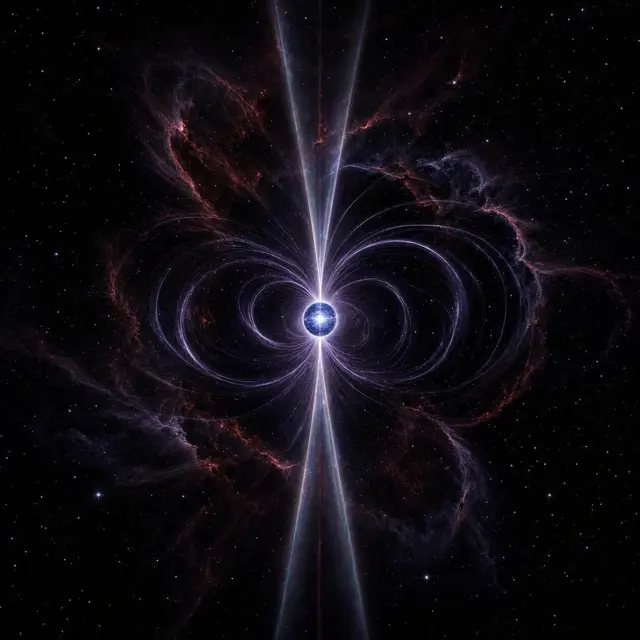
A pulsar is a highly magnetized, rapidly rotating neutron star that fires beams of electromagnetic radiation out of its magnetic poles. You only see it when a beam happens to sweep across Earth, exactly the way a lighthouse is only visible when its light points at you. That sweeping is what makes the emission look pulsed.
The theory arrived before the observation. Walter Baade and Fritz Zwicky proposed the existence of neutron stars in 1934, arguing that a small, dense star made mostly of neutrons would be left behind by a supernova. In 1964 Lodewijk Woltjer suggested such objects might carry magnetic fields as large as 10 to the 14th through 10 to the 16th gauss.
In 1967, just before the discovery, Franco Pacini suggested that a rotating neutron star with a magnetic field would emit radiation. After Bell's find, Thomas Gold independently proposed the same rotating model and argued explicitly that it explained the observed pulses.
The Crab Settles the Argument
The model still needed proof. It came in 1968, when Richard V. E. Lovelace and collaborators used the Arecibo Observatory to measure the period of the pulsar in the Crab Nebula at roughly 33 milliseconds.
That number did the work. A 33 millisecond pulse period was simply too short to be consistent with the other models people had proposed for pulsar emission, leaving the rotating neutron star as the explanation standing.
Better still, it sat exactly where the theory said it should. The Crab Pulsar is named for its position at the centre of the Crab Nebula, a supernova remnant, which matched the prediction Baade and Zwicky had made three decades earlier that neutron stars are what supernovae leave behind. Although the first pulsar was found at radio wavelengths, pulsars have since been found emitting in visible light, X-ray and gamma ray wavelengths too.
Clocks That Can Outperform Atomic Clocks
In 1982 a group led by Don Backer found PSR B1937+21, spinning once every 1.6 milliseconds. That is about 38,500 revolutions per minute, from an object heavier than the Sun.
Its magnetic field was much weaker than an ordinary pulsar's, and further finds established a whole new class: millisecond pulsars, believed to be the end product of X-ray binaries. Their rotation is so rapid and so stable that they work as clocks rivalling the best atomic clocks on Earth. Anything that shifts a pulse's arrival time by more than a few hundred nanoseconds can be detected and measured, which lets astronomers extract a pulsar's position in three dimensions, its motion, and the properties of any companion.
That precision has paid off twice over. In 1974 Joseph Hooton Taylor Jr. and Russell Hulse found a pulsar orbiting another neutron star every eight hours, and watching its orbit shrink gave the first evidence that gravitational waves exist, winning the 1993 Nobel Prize. In 1992 Aleksander Wolszczan found the first known planets outside the Solar System orbiting the pulsar PSR B1257+12.
The Nobel That Left Out the Discoverer
In 1974 Antony Hewish and Martin Ryle became the first astronomers ever awarded the Nobel Prize in Physics, with the Royal Swedish Academy of Sciences noting that Hewish had played a "decisive role in the discovery of pulsars".
Jocelyn Bell, who spotted the signal, pushed back against her supervisor's dismissal of it and found the second source that killed the alien theory, was not included. She had been his PhD student at the time. Considerable controversy has surrounded the omission ever since, though Bell herself claims no bitterness on the point and has supported the prize committee's decision.
The word itself entered the language remarkably fast. "Pulsar" first appeared in print in 1968, in a piece quoting Hewish saying "I am sure that today every radio telescope is looking at the Pulsars." Within a year, an object nobody had known existed had a name, a mechanism and the full attention of the field.