The Sun's Future Growth Spurt
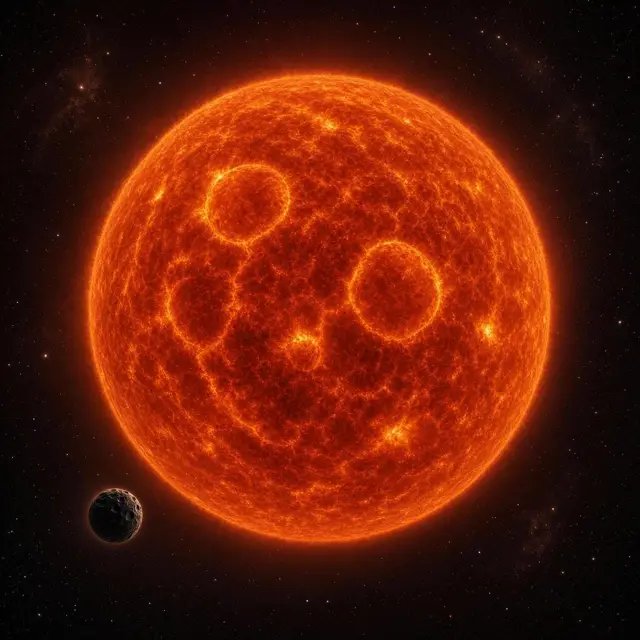
Our Sun is not done changing. In about 5 billion years it will leave the main sequence and start turning into a red giant. It will grow to over 200 times its present radius, which is about 1.2 times the current distance between Earth and the Sun. At that size it will swallow Mercury, Venus and likely Earth.
This growth comes at a cost. The Sun will lose 38% of its mass as it swells. After that, it will shrink back down to become a small, dense white dwarf.
The Sun will be in good company. Many well-known bright stars in our sky are red giants, because they are both very luminous and fairly common. Arcturus, 36 light-years away, is one of them. Gacrux, at 88 light-years, is the nearest giant of the cool M class. Aldebaran and Mira are red giants too, each at a different stage of the giant life.
How a Starving Core Inflates a Star
A red giant is born when a star runs out of hydrogen fuel in its core. For the Sun, that steady hydrogen-burning stage lasts about 10 billion years. When the core's fuel runs low, its nuclear reactions slow down. The core can no longer push back against gravity, so it shrinks and heats up.
Soon a layer around the core gets hot enough to fuse hydrogen on its own. This is called shell burning. The extra energy pours into the outer layers, which swell enormously and cool down.
Astronomers describe this with the mirror principle: when the core inside the shell shrinks, the layers outside it must expand. The full physics is complex, but it follows from the star balancing its gravitational and thermal energy. Once the puffed-up outer layers cool enough, the star stops growing, its brightness starts to climb, and it begins moving up what astronomers call the red-giant branch.
Huge, Bright and Blurry at the Edges
Red giants are enormous. Their radii are tens to hundreds of times larger than the Sun's. Their surfaces are cooler, around 3,000 to 4,000 K for the K and M types, compared with nearly 6,000 K for the Sun. Yet because they are so big, they can shine up to nearly three thousand times brighter than the Sun.
Pictures usually draw them with a crisp edge, but that is not accurate. Their outer layers are so thin that the star has no clear surface. It simply fades gradually into its outer atmosphere.
Their surfaces also bubble differently. The Sun's surface is covered with many small cells of rising hot gas. A red giant has just a few huge ones, and these cause the brightness changes so common in red giants. Some giants also carry carbon from deep inside up to the surface in an event called a dredge-up, creating what astronomers call carbon stars.
The Helium Flash and the Final Exit
For stars like the Sun, the shrinking core eventually gets so dense that it cannot collapse further. It keeps heating up until it reaches roughly 100 million K. At that point helium starts fusing into carbon, and the whole core ignites almost at once. This sudden moment is called the helium flash. Heavier stars skip it and start burning helium much more smoothly.
Later, when the core's helium runs out, the star swells again into a second red-giant phase. In the end it throws off its outer layers, forming a planetary nebula, and its exposed core becomes a white dwarf. For a star with the Sun's mass, the whole red-giant phase lasts only about a billion years.
Not every star gets this ending. The smallest stars may keep fusing hydrogen for up to a trillion years and never become red giants at all. The most massive stars become supergiants instead and usually end their lives as a supernova.
Can Planets Live Next to a Giant?
For a long time, scientists assumed that a star turning into a red giant would make its planets unlivable. Some research now suggests otherwise. For a star with the Sun's mass, a habitable zone could last several billion years at twice the Earth-Sun distance while the star climbs the red-giant branch. That might be enough time for life to develop on a suitable world.
Later studies refined the picture. They found the window lasts from 100 million years for a planet in a Mars-like orbit up to 370 million years for one at Jupiter's distance.
Giant stars may even feed their planets. By 2023, several hundred giant planets had been found around giant stars, and they are heavier than those found around Sun-like stars. One explanation is that the planets grow during the red-giant phase. As the star swells out to a planet's orbit, it can spill its own material onto the planet.