When Galileo Thought Saturn Had Ears
In 1610, Galileo became the first person to see Saturn's rings. But his telescope was not good enough to show what they really were. He thought Saturn was made of three bodies sitting in a line, almost touching. He also described the rings as Saturn's "ears".
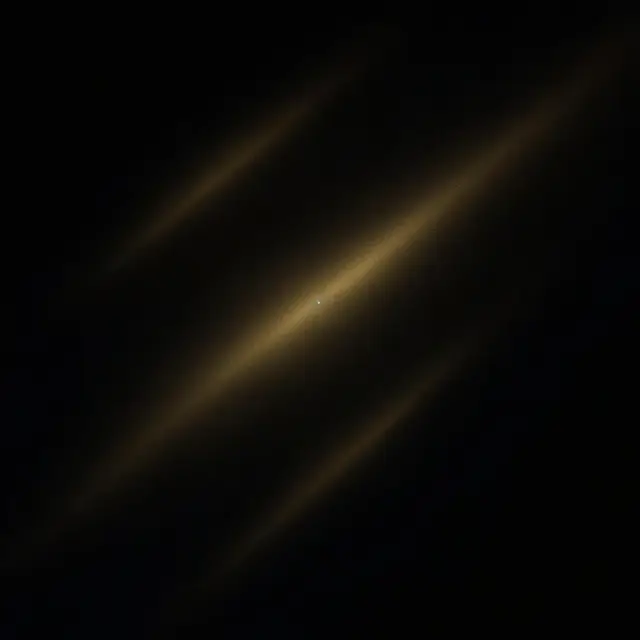
Then in 1612, Earth passed through the plane of the rings, and they vanished from view. Galileo was baffled. "I do not know what to say in a case so surprising, so unlooked for and so novel," he wrote. He was confused all over again when the rings came back in 1613.
Astronomers back then had a clever way to claim a discovery before they were ready to publish. They wrote it as a scrambled anagram. In 1655, Christiaan Huygens, using a telescope he designed himself, became the first to describe a disk around Saturn. He hid his idea in a jumble of letters. Three years later, he revealed it described a thin, flat ring that touches the planet nowhere.
Countless Ice Chunks, Not One Ring
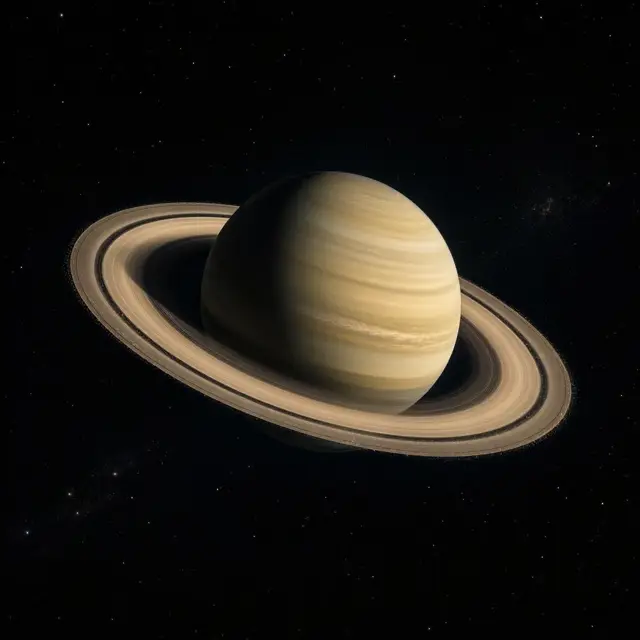
The rings are not solid. In 1859, James Clerk Maxwell showed that a solid or liquid ring would not be stable. Instead, they must be made of huge numbers of small pieces, each orbiting Saturn on its own. Studies in 1895 showed he was right.
Those pieces range from micrometers to meters in size. They are 99.9% pure water ice, with a trace of rocky material. The main rings stretch from 7,000 km to 80,000 km from Saturn's equator. Yet in places they may be as thin as 10 meters.
The Cassini spacecraft measured their mass on its final orbits, flying between the rings and the cloud tops. The total is around two-thirds the mass of Earth's whole Antarctic ice sheet, spread over an area 80 times larger than Earth's surface. The rings even have their own oxygen atmosphere, made when sunlight hits the ice. It is so thin that, squeezed onto the rings, it would be about one atom thick.
Tiny Moons That Carve the Gaps
Look closely and the rings have thousands of thin gaps and ringlets. In 1675, Giovanni Domenico Cassini saw that the ring was really several rings with gaps between them. The biggest gap, the Cassini Division, is 4,800 km (3,000 mi) wide. The rings are named with letters in the order they were discovered.
Many gaps are carved by moons. The tiny moon Pan orbits inside the Encke Gap and keeps it clear. Another small moon, Daphnis, keeps the Keeler Gap open. Its tilted orbit raises waves along the gap's edges that reach 1,500 m above the ring plane. Some narrow rings are held in shape by shepherd moons.
In 2006, Cassini also found propeller moonlets in the A Ring. They are only about a hundred meters across, too small to see directly. What shows up are the propeller-shaped ripples they make, several kilometers wide. By 2008, over 150 had been detected. One that was tracked for several years got the nickname Bleriot.
Ghostly Spokes and a Giant Hidden Ring
In 1980, Voyager images showed strange streaks across the B Ring called spokes. Gravity could not explain them, because of the way they lasted and turned. The leading idea is that they are tiny dust grains lifted off the ring by electric forces. The exact cause is still unknown.
The spokes seem to come and go with the seasons. They disappear in Saturn's midwinter and midsummer and return as the planet nears its equinox. Cassini did not see any when it arrived in 2004, but spotted them again on 5 September 2005.
Much farther out lies the Phoebe ring, reported in 2009 after a search with the Spitzer infrared telescope. Seen from Earth, it would look as wide as two full moons, yet it is almost invisible. It is tilted 27 degrees to the main rings, and its particles are thought to orbit in the opposite direction to the nearby moon Iapetus. Meanwhile, the wide E Ring is fed by icy plumes from the moon Enceladus.
Rings That Are Raining Away
Nobody agrees on when the rings formed. Some thought they were as old as Saturn itself. But Cassini data suggests they are much younger, likely between 10 million and 100 million years old. Their bright, clean ice is cited as evidence too, since dust falling in over time should have darkened them.
One idea is that they were once a moon. Its orbit shrank until it crossed the Roche limit and was ripped apart. Simulations in 2022 supported this and named the lost moon "Chrysalis". Simulations in 2023 showed that two icy moons smashing together could explain why the rings have so little rock.
The rings are also slowly disappearing. Charged ice grains get pulled down into Saturn along its magnetic field, a process called ring rain. In September 2017, Cassini also detected material flowing from the rings straight into the planet. Together, these suggest the rings may be gone in under 100 million years.