A Planet That Would Float
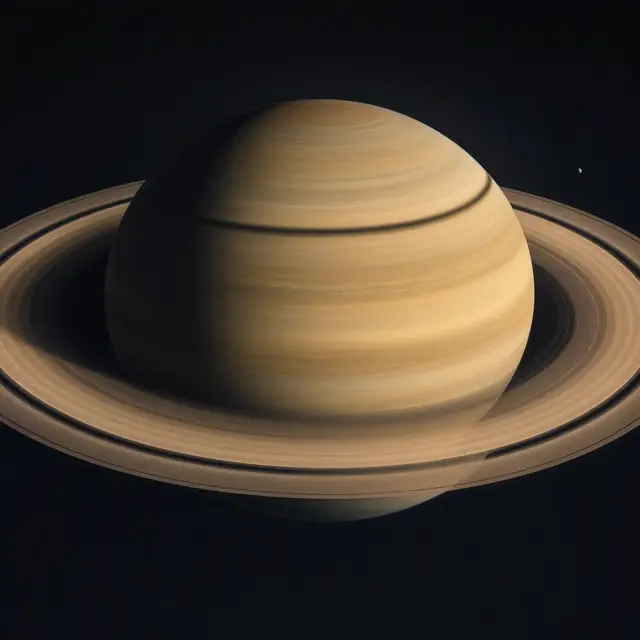
Saturn is the sixth planet from the Sun and the second largest, with an average radius about nine times Earth's and a mass over 95 times greater. It is also, strangely, the lightest thing of its size in the neighbourhood.
Saturn is the only planet in the Solar System less dense than water, by about 30%. Its average density is 0.69 grams per cubic centimetre. The usual way of putting this is that it would float, which is true in the arithmetic and impossible in practice, but it tells you what kind of object this is: a gas giant with no solid surface, made mostly of hydrogen and helium.
The comparison with Jupiter is the sharpest way to feel it. Saturn is almost as big as Jupiter but has less than a third of its mass. Between them, the two planets hold 92% of all the planetary mass in the Solar System.
Metal Hydrogen and Raining Diamonds
Go down far enough and the hydrogen stops behaving like a gas. Pressure, temperature and density all climb steadily toward the centre, and in the deeper layers hydrogen turns into a metal.
The structure runs roughly like this: a diffuse core of rock and ice extending about 60% of the way out, with a mass equal to around 17 Earths, wrapped in a thick layer of liquid metallic hydrogen, then a layer of helium-saturated liquid hydrogen, and finally about 1,000 km of actual gas at the top. The core reaches around 11,700 °C.
That heat is a genuine puzzle. Saturn radiates 2.5 times more energy into space than it receives from the Sun, more than slow gravitational squeezing can easily explain. One proposed answer is helium rain: droplets of helium condensing and falling through the lighter hydrogen, releasing heat by friction as they go. Rainfalls of diamonds have also been suggested inside Saturn.
The Rings, and the 293 Moons
The rings are the reason anyone recognises Saturn at a glance. They are bright and extensive, and made mainly of ice particles, with a smaller amount of rocky debris and dust.
The company Saturn keeps is even more crowded than the rings suggest. At least 293 moons orbit the planet, of which only 63 are officially named, and that count does not include the hundreds of moonlets sitting inside the rings themselves.
One of them is a world in its own right. Titan, Saturn's largest moon and the second largest in the Solar System, is bigger than the planet Mercury, though less massive, and it is the only moon anywhere in the Solar System with a substantial atmosphere. That atmosphere is thick enough to hide the surface completely: when Voyager 1 flew past, it proved that Titan's air is impenetrable at visible wavelengths, so no surface detail could be seen at all.
The Hexagon at the North Pole
Saturn's outer atmosphere is usually described as bland, pale yellow from ammonia crystals high up, and short on contrast. It is not short on weather. Winds there can reach 1,800 kilometres per hour.
And at about 78° north there is a feature nobody expected. A persistent six-sided wave pattern surrounds the north polar vortex, first noticed in the Voyager images. Each side of the hexagon is about 14,500 km long, which is longer than the diameter of Earth. The whole structure rotates with a period of 10 hours, 39 minutes and 24 seconds.
Even working out how fast Saturn spins is awkward, because a ball of gas has no fixed landmarks. Astronomers use three different systems for different latitudes, and the interior figure has kept shifting with better measurements. Part of the confusion may come from the moon Enceladus, whose geysers feed charged water vapour into Saturn's magnetic field and drag on it slightly.