Common Everywhere, Rare Anywhere
A solar eclipse happens when the Moon passes between Earth and the Sun, blocking the view of the Sun from a small part of our planet.
The frequency depends entirely on how you count. Total solar eclipses occur somewhere on Earth every 18 months on average, which makes them sound routine. But because a solar eclipse can only be seen from a relatively small area, any particular place on Earth gets one only once every 360 to 410 years.
That is the difference between the event and the experience. Lunar eclipses can be watched from anywhere on the night side of the planet. Solar eclipses come to you, or they do not.
In any given year there are at least two solar eclipses and there can be as many as five, though no more than two of them can be total. Astronomers in China were predicting them as early as the 4th century BC, and eclipses hundreds of years ahead can now be predicted with high accuracy.
Why It Does Not Happen Every Month
There is a new moon roughly every 29.5 days, and at every new moon the Moon sits between us and the Sun. So why is the sky not going dark monthly?
The answer is a tilt. If the Moon orbited in exactly the same plane as Earth's orbit, there would be a total solar eclipse at every new moon. Instead the Moon's orbit is tilted at about 5 degrees, so its shadow usually misses Earth entirely, passing above or below.
An eclipse can only happen when a new moon falls close to one of the two nodes, the points where the Moon's orbital path crosses Earth's. Those line up with the Sun twice a year, about 173 days apart, in what are called eclipse seasons.
The geometry is fussy in a precise way. Eclipses can only occur when the Sun is within about 15 to 18 degrees of a node, and only 10 to 12 degrees for a central eclipse.
Usually the Moon Is Too Small
Here is the detail that surprises people who assume totality is the default. On average, the Moon appears slightly smaller than the Sun in our sky, by about 2.1%.
The consequence is that about 60% of central eclipses are annular rather than total. Instead of the Sun being covered completely, a bright ring of it stays visible all the way around the Moon. Totality only happens when the Moon is closer to Earth than average, near its perigee.
That variation comes from the shape of the orbit. The Moon's distance from Earth varies by up to about 5.9% from its average, which changes its apparent size noticeably. Earth's distance from the Sun varies too, but far less, only about 0.85%.
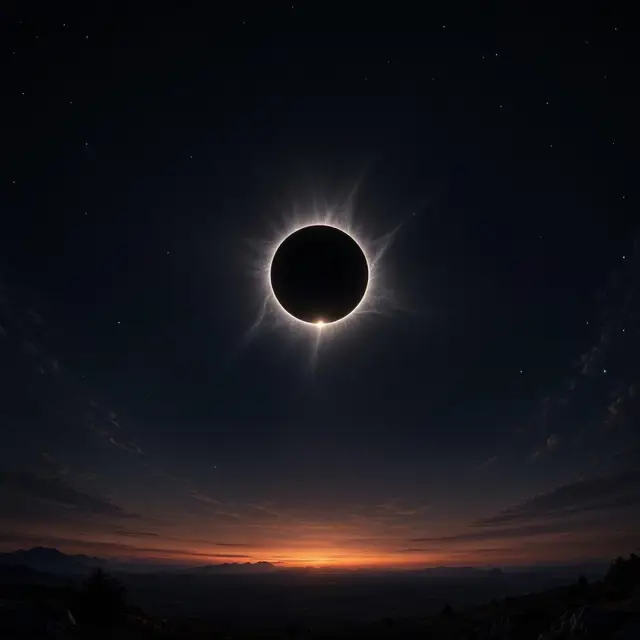
So the famous image of a black disc perfectly plugging the Sun is the minority case, produced by a coincidence of distances that has to line up just right.
Three Shadows, and One Rule About Looking
An eclipse casts more than one kind of shadow, and which one you are standing in decides what you see.
The umbra is the dark core where the Sun is completely blocked, and the small patch where it touches Earth's surface is the only place a total eclipse is visible. The much larger penumbra around it gives a partial eclipse. Beyond the umbra lies the antumbra, and an observer there sees the annular ring.
That shadow moves fast. The Moon travels in the same direction as Earth's rotation but much quicker, at about 61 kilometres per minute against Earth's 28 at the equator, so the shadow sweeps roughly west to east across the map.
One piece of safety is worth stating plainly. Looking directly at the Sun can cause permanent eye damage, so eye protection or indirect viewing is needed at every stage except the total phase itself, which is safe to watch unprotected. Enthusiasts who travel the world chasing them are called umbraphiles.