One Star Holds Almost All of It
Here is the number that reframes everything: the Sun accounts for 99.86% of the Solar System's total mass. Every planet, every moon, every asteroid and comet combined make up the remaining sliver.
Inside the Sun's core, hydrogen is fused into helium, and the energy released is emitted through the photosphere. That outflow creates the heliosphere and a temperature gradient that drops steadily the further out you go.
The whole system formed about 4.6 billion years ago, when a dense region of a molecular cloud collapsed. That collapse made the Sun and a protoplanetary disc, and everything orbiting today assembled out of that disc.
The Line Where Rock Gives Way to Gas
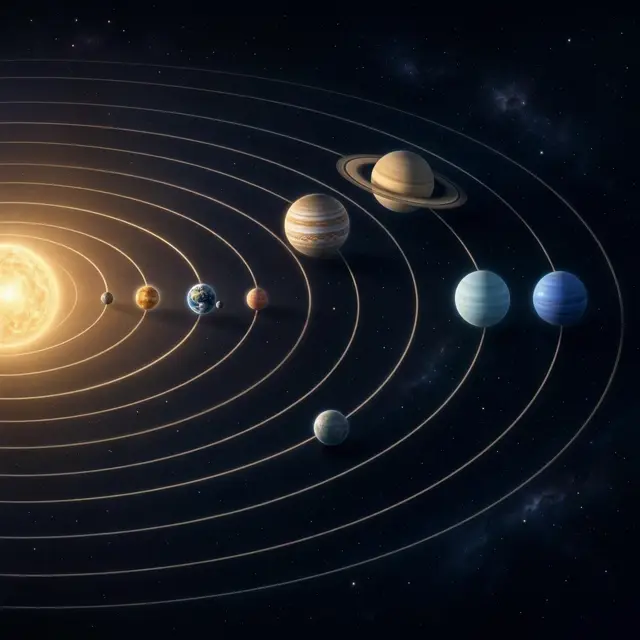
The four planets closest to the Sun are the terrestrial planets: Mercury, Venus, Earth and Mars. They form the inner Solar System, and Earth and Mars are the only two that orbit within the Sun's habitable zone, where sunlight can keep surface water liquid.
At about five astronomical units out sits the frost line. Beyond it, the character of the system changes completely.
There you find the two gas giants, Jupiter and Saturn, and the two ice giants, Uranus and Neptune. Jupiter and Saturn alone hold nearly 90% of all the non-stellar mass in the Solar System, meaning almost everything that is not the Sun.
Moons Larger Than Planets
Ganymede orbits Jupiter and Titan orbits Saturn, and both of them are larger than Mercury, the smallest planet. They are less massive, but physically bigger.
It goes further. The seven most massive moons, a group that includes Earth's own Moon, are each both more massive and larger than any dwarf planet in the Solar System.
The International Astronomical Union's Minor Planet Center lists Ceres, Pluto, Eris, Makemake and Haumea as dwarf planets, and four others are generally identified as such: Orcus, Quaoar, Gonggong and Sedna. Ceres sits in the asteroid belt between Mars and Jupiter, while the rest are trans-Neptunian objects out in the Kuiper belt or the scattered disc.
Where the Solar System Actually Ends
The answer depends on what you count. At around 70 to 90 astronomical units, the solar wind is finally halted by the interstellar medium, creating a boundary called the heliopause.
But the Sun's gravity reaches vastly further. The theorised Oort cloud, the source of long-period comets, extends from somewhere beyond 2,000 AU outward, and the true edge is the Sun's Hill sphere at 178,000 to 227,000 AU, which is 2.81 to 3.59 light years. That is where the Sun's pull finally equals the pull of the galaxy itself.
For scale, the closest star, Proxima Centauri, is 269,000 AU away, or 4.25 light years. Our nearest neighbour is barely past our own back fence.