The Sun Is Always Leaking
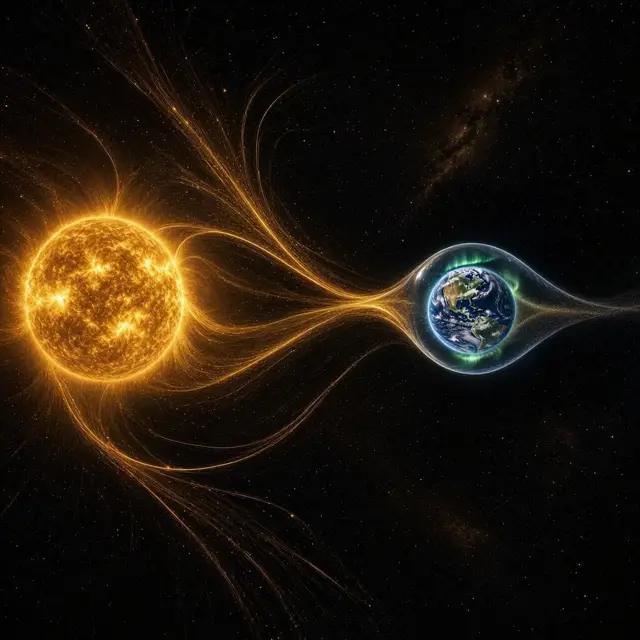
The Sun never stops blowing. Its outer layer, the corona, is heated to over a million degrees, so hot that some particles escape the Sun's gravity and stream out into space. This steady flow of electrically charged particles, mostly electrons, protons and alpha particles, is the solar wind.
It moves fast. A few solar radii out from the Sun, the wind races at 250 to 750 kilometers per second. Every second, the Sun loses about 1.3 to 1.9 million tonnes this way. That adds up to a mass equal to the Earth every 150 million years.
The Sun is not about to blow itself away, though. Since it formed, it has lost only about 0.01% of its starting mass to the wind. Over its long life, the wind has also slowed the spin of the Sun's surface. Other stars blow much stronger winds and lose mass far faster.
Clues From Comets and Northern Lights
In 1859, Richard Carrington and Richard Hodgson each spotted a sudden bright patch on the Sun, now called a solar flare. The next day, a powerful magnetic storm hit Earth. Carrington suspected a link. Today we know the storm came from a burst of solar material that crossed space and struck Earth's magnetic field.
Other scientists added more pieces. Kristian Birkeland noticed that auroras glowed almost without a break and decided Earth was being hit all the time by particles from the Sun. In 1916, he proposed that those particles came with both negative and positive charges.
Comets gave another clue. A comet's tail always points away from the Sun, no matter which way the comet is flying. In the 1950s, Ludwig Biermann suggested that a steady stream of particles from the Sun was pushing the tails back. Around the same time, Sydney Chapman worked out that the hot corona must reach out beyond Earth's orbit.
Four Lines of Algebra and a Rude Review
Then Eugene Parker connected the dots. He argued that a corona this hot cannot sit still, so it must keep flowing outward and speed up until it becomes supersonic. Parker said the math behind the discovery took just "four lines of algebra." He picked the name because it is really just a flowing gas.
When he sent his paper to The Astrophysical Journal in 1958, two reviewers said to reject it. One wrote that Parker should "go to the library and read up on the subject" because it was "utter nonsense." The editor, Subrahmanyan Chandrasekhar, found no obvious errors and published it anyway, even though he disagreed with the theory.
Space soon settled the argument. In January 1959, the Soviet spacecraft Luna 1 measured the solar wind directly. In 2018, NASA launched the Parker Solar Probe, its first spacecraft named after a living person, and Parker, at age 91, was there to watch the launch.
Earth's Invisible Shield
Earth has a defense. Its magnetic field forms a bubble called the magnetosphere, which steers most solar wind particles around the planet instead of letting them hit the air. It is rounded on the side facing the Sun and stretched into a long tail on the far side.
Sometimes the Sun hurls huge, fast bursts of plasma known as coronal mass ejections. When one hits Earth, it bends our magnetic field, swings compass needles and drives large electric currents through the ground. Particles get pushed down toward the atmosphere, where they light up the sky as the aurora.
Strange things happen when the wind drops, too. From May 10 to May 12, 1999, spacecraft saw the solar wind's density fall by 98%. During that lull, Earth's magnetosphere swelled to 5 to 6 times its normal size, and a rare "polar rain" event painted a visible aurora over the North Pole.
Stripping Mars and Blowing a Bubble
Planets without a strong magnetic shield have it rough. The solar wind is thought to have stripped away up to a third of Mars's original atmosphere. In 2015, NASA's MAVEN mission measured Mars still losing about 100 grams of its air to space every second.
Far out, the wind finally runs out of push. It blows a giant bubble in the thin gas between the stars. The place where it can no longer push that gas back is the heliopause, often treated as the outer border of the Solar System, far beyond Pluto's orbit.
Voyager 1 found that edge at about 120 astronomical units, roughly 18 billion kilometers away. In December 2010, it reported that the solar wind around it had stopped moving outward and was only drifting sideways. And in 2021, the Parker Solar Probe crossed the boundary between the corona and the solar wind, 18.8 solar radii from the Sun.