Half Rocket, Half Glider
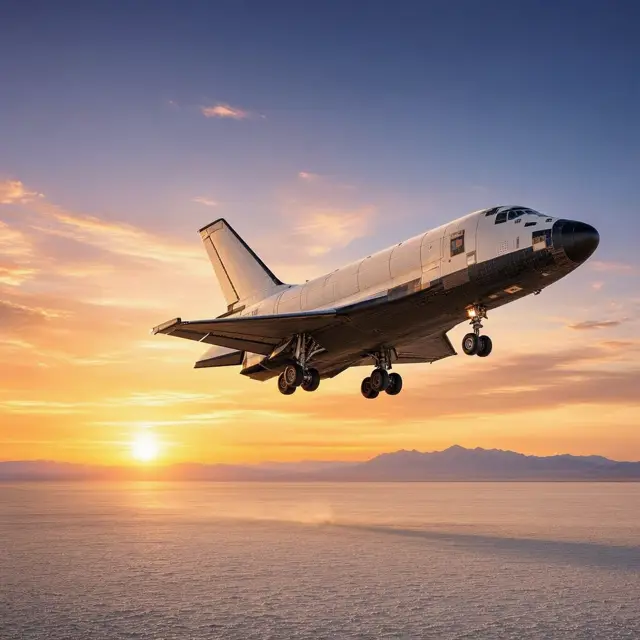
The Space Shuttle launched like a rocket and landed like a glider. NASA flew it from 1981 to 2011, and five orbiters made a total of 135 missions. Together they spent 1,323 days on missions.
The system had three main parts. The winged orbiter carried the crew, the cargo and three main engines. Two solid rocket boosters were strapped to the sides. Between them sat a giant orange external tank full of liquid hydrogen and liquid oxygen for the engines. The boosters were fished out of the sea and reused, but the tank was the only major part thrown away each time.
Getting home could be a trip of its own. If an orbiter landed in California instead of Florida, it rode back on top of a specially modified Boeing 747. The very first orbiter, Enterprise, never went to space. It was built for landing tests.
The Twang, Then Two Minutes of Thunder
Launch day was a carefully timed dance. Sixteen seconds before liftoff, a sound suppression system drenched the launch platform with 1,100,000 liters of water. This protected the shuttle from the force of sound and exhaust bouncing back up.
At 6.6 seconds before liftoff, the three main engines lit one after another. Because the boosters were still bolted to the pad, the off-center push tilted the whole stack about 65 centimeters at the tip of the tank. Engineers nicknamed this sway the "twang". The countdown waited three seconds for the stack to swing back upright before the boosters fired.
Those boosters were the largest solid-fuel rocket motors ever flown. They gave 71.4 percent of the thrust at liftoff. After about two minutes, they dropped away, parachuted into the ocean and were picked up by ships to be refurbished and flown again.
Coming Home at Mach 25
Coming home took just as much care. The orbiter flew upside down and tail first while it fired its engines to slow down. It reached the upper atmosphere at about Mach 25, roughly twenty-five times the speed of sound.
To survive, it wore a thermal protection system made mostly of tiles. Outside, temperatures reached 1,600 °C, yet the aluminum skin underneath had to stay below 180 °C. The hottest spots, the nose and the front edges of the wings, used a tough carbon material. Tiles could be replaced one by one, which made the shuttle reusable. Columbia needed 30,000 of them. When it arrived in Florida in 1979, 6,000 were still missing, and the tile work took two more years.
The orbiter glided in to land without engine power. It touched down at between 100 and 150 meters per second, then opened a drag parachute from its tail to slow down.
A Delivery Truck to Orbit
The shuttle's real job was hauling things. Its payload bay was 18 meters long and 4.6 meters wide. The bay doors even doubled as radiators, opened in orbit to get rid of heat.
Inside the bay sat a robotic arm called Canadarm, built by a Canadian company. Astronauts steered it from the flight deck, using windows and TV cameras, to grab cargo or to carry astronauts on spacewalks. The shuttle launched the Hubble Space Telescope along with many satellites and space probes. It also carried Spacelab, a European-funded laboratory whose hardware flew on 28 missions.
Later, the shuttle docked with Russia's Mir space station. In its final decade, it helped build the International Space Station. A typical crew had seven astronauts, and one mission flew with eight. The longest mission lasted 17 days and 15 hours.
Big Promises and Second Lives
The shuttle was meant to make spaceflight cheap. Estimates from 1972 promised payload costs as low as $1,109 per pound, in 2012 dollars. The real figure was about $37,207 per pound, and the whole program cost an estimated $221 billion.
Two orbiters were lost in accidents: Challenger in 1986 and Columbia in 2003. After the final flight, by Atlantis in July 2011, the United States used Russian Soyuz spacecraft to send its astronauts to the space station until 2020.
Today the orbiters are museum stars. Atlantis is at the Kennedy Space Center in Florida, Discovery in Virginia, Endeavour in Los Angeles and Enterprise in New York. Even the two carrier 747s are on display. And the hardware keeps flying. NASA's Artemis program reuses old shuttle main engines and boosters. Artemis I had parts that had flown on 83 of the 135 shuttle missions.