Three Failures From the End
SpaceX almost did not survive its own beginning. Founded in 2002 by Elon Musk with the goal of cutting the cost of spaceflight, it suffered three failed launch attempts between 2006 and 2008 that nearly pushed the company into bankruptcy.
The fourth worked. In 2008 the Falcon 1 reached orbit, making SpaceX the first private company to develop and launch a liquid-fuelled rocket to orbit.
The approach behind it was deliberately unglamorous. Musk believed launch costs could be cut hard by using vertical integration, buying inexpensive off-the-shelf commercial components where possible, and borrowing the modular habits of modern software engineering. The company was first headquartered in a warehouse in El Segundo, California, and its early staff included the engineer Tom Mueller.
Landing the Thing You Just Launched
In 2010 SpaceX launched the Falcon 9 rocket and the Dragon 1 spacecraft to fulfil NASA contracts for cargo deliveries to the International Space Station. By 2012 it was flying resupply missions and became the first private company to dock with the station.
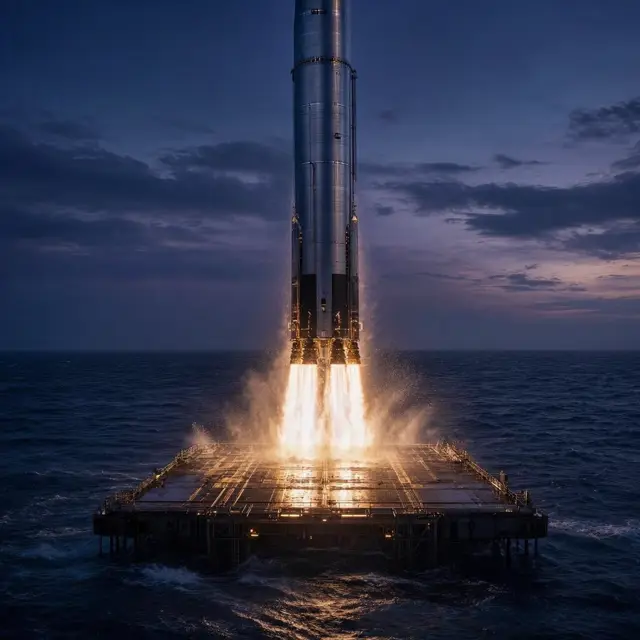
Then came the part everyone remembers. In 2015, Falcon 9 flight 20 achieved the first successful landing of an orbital-class rocket's first stage. In 2017 the SES-10 mission completed the first reflight of a used orbital-class booster, turning rockets from single-use objects into vehicles.
The scale that followed is hard to absorb. Falcon Heavy, built from three Falcon 9-derived boosters, made its maiden flight in 2018. As of May 2026, Falcon 9 was launching roughly three missions a week, and Falcon boosters had completed nearly 650 landings and reflights. SpaceX now conducts more orbital launches a year than any other provider, including national programmes.
A Rocket Company That Sells Internet
The business that pays for the rockets is not really rockets. In 2019 the first operational satellite of Starlink came online, and the satellite constellation has since generated the bulk of SpaceX's income.
Starlink provides satellite-based high-speed broadband, and it spawned a military counterpart called Starshield. Connectivity is now one of the company's three primary segments, alongside Space and AI.
The crewed side grew too. In 2020 SpaceX began flying its Dragon 2 capsules for NASA and for private customers. Around the same time it started building test prototypes for Starship, the largest launch vehicle in history, which it plans to adapt as a human lander for lunar missions under NASA's Artemis programme. Its largest customers are NASA, the United States Space Force and the National Reconnaissance Office.
2026: Chips, AI and the Biggest Debut Ever
In 2026 SpaceX stopped being only an aerospace company. It acquired Musk's artificial intelligence firm xAI, which now operates as the wholly owned subsidiary SpaceXAI, developing the Grok family of large language models, running the social network X, and building large-scale data centres.
It also announced a joint venture with Tesla to build Terafab, a large semiconductor fabrication plant. The company is headquartered at the Starbase development site in Starbase, Texas.
The financial milestone came on 12 June 2026, when SpaceX's initial public offering raised 86 billion dollars, the largest in history, and briefly made Musk the first US-dollar trillionaire. Musk owns 39% of the outstanding shares but controls 84% of the voting power through super-voting stock, so the listing did not loosen his grip on the company.