Brighter Than a Galaxy
A supernova is the explosion of a star, and at its peak it can shine about as brightly as the entire galaxy around it before fading over weeks or months.
What is left depends on what exploded. The original star, called the progenitor, either collapses into a neutron star or a black hole, or is destroyed outright and leaves only a spreading cloud of gas.
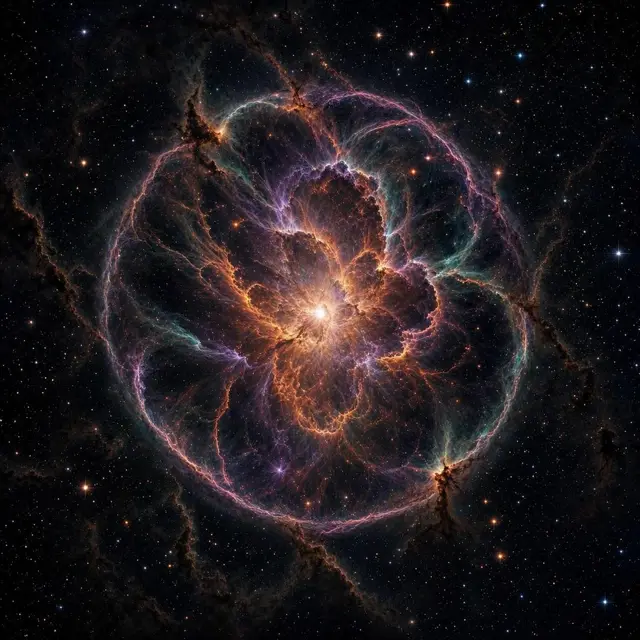
The explosion throws off several times the mass of the Sun at speeds reaching a few percent of the speed of light. That drives a shock wave into the surrounding space, sweeping up an expanding shell of gas and dust known as a supernova remnant.
The consequences reach further than the debris. Supernovae are a major source of the elements between oxygen and rubidium, which means most of the heavier material around us was made in one. Their shock waves can compress nearby gas and trigger the formation of new stars, and they are a major source of cosmic rays.
The name was coined around 1931 to distinguish these from ordinary novae, which are far fainter.
Two Ways for a Star to Blow Up
Almost all supernovae come from one of two mechanisms, and they are very different processes with a similar result.
The first is a white dwarf that gets pushed past its limit. Sitting in a binary system, it pulls material off its companion until the core grows hot enough to ignite carbon fusion, which runs away and destroys the star completely. Two white dwarfs colliding can do the same. These explosions have remarkably uniform properties, which is why astronomers use them as standard candles for measuring cosmic distances.
The second is core collapse, which drives every other type. A massive star fuses progressively heavier elements until it builds an iron core, at which point fusion can no longer generate the energy needed to hold the star up against its own gravity. The core falls in, and the outer layers are blown violently outward.
If too little energy is released, there is no bright explosion at all. The star simply collapses into a neutron star or black hole quietly.
What People Saw
Fewer than ten supernovae have been observed with the naked eye in the past 2,000 years, aside from telescope discoveries.
SN 1006 was the first widely recorded one, described by observers in China, Japan, Iraq, Egypt and Europe. The supernova of 1054, recorded by Chinese astronomers, produced what we now call the Crab Nebula.
Two later ones changed European science. Tycho Brahe observed one in 1572 and Johannes Kepler another in 1604, and because both appeared and faded in what was supposed to be a fixed and unchanging sky, they became arguments against the Aristotelian view of the heavens. Kepler watched his from its peak on 17 October 1604 until it faded from view a year later.
No supernova in our own galaxy has been seen with the naked eye since. The nearest modern equivalent was SN 1987A in the Large Magellanic Cloud, which produced the only measurement of neutrinos from a source other than the Sun.
Hunting Them Now
Supernovae are rare in any single galaxy, occurring in the Milky Way somewhere between about 1.6 and 4.6 times per century, so finding them means watching an enormous number of galaxies at once.
Astronomers now find roughly two thousand a year. Amateurs matter here, since they vastly outnumber professionals and have historically spotted many by comparing telescope views of nearby galaxies against older photographs. Since the late 20th century, computer-controlled telescopes have taken over much of the work.
Timing is the problem. Supernovae cannot be predicted, and they are usually already underway when discovered, yet using them as distance markers requires catching the peak. One project uses a network of neutrino detectors as an early warning system, since neutrinos pour out of a collapsing core and pass straight through the gas and dust that would block light.
In 2016 an amateur in Argentina happened to be pointed at the right galaxy and caught the first moments of an explosion, something never previously observed.