The Star the Computers Missed
NASA's Kepler space telescope stared at one patch of sky from 2009 to 2013, watching over a hundred thousand stars for the tiny, regular flickers caused by orbiting planets. Its software was tuned to find repeating patterns. But in the constellation Cygnus, one star was doing something so strange the algorithms sailed right past it.
It took human eyes to catch it. Volunteers of the Planet Hunters project — ordinary people reviewing Kepler data online — flagged the star's bizarre behavior. In 2015, astronomer Tabetha Boyajian led the paper announcing the discovery, and the star, cataloged as KIC 8462852 and observed since 1890 without anyone noticing anything odd, became known as Tabby's Star.
Dips That Break the Rules
When a planet crosses a star, the light dims predictably: a Jupiter-sized world blocks about 1%, on a repeating schedule. Tabby's Star obeys no such rules. In March 2011 it plunged by up to 15%. In February 2013, by 22%. Whatever blocked that light must span roughly half the star's width — and the dips repeat on no discernible schedule, with odd asymmetric shapes.
The strangeness continued after Kepler. A 2017 observing campaign caught four dips that researchers named Elsie, Celeste, Skara Brae, and Angkor, and in March 2018 came a 5% dip, the deepest since 2013. On top of the sudden dips, the star is also gradually fading over the years — a slow dimming layered on the chaos.
When Aliens Made the Shortlist
Among the proposed explanations was one that made headlines worldwide: a Dyson swarm — a vast fleet of energy-collecting structures built around the star by an advanced civilization. Astronomer Jason Wright noted the idea was at least falsifiable science, even if wildly unlikely.
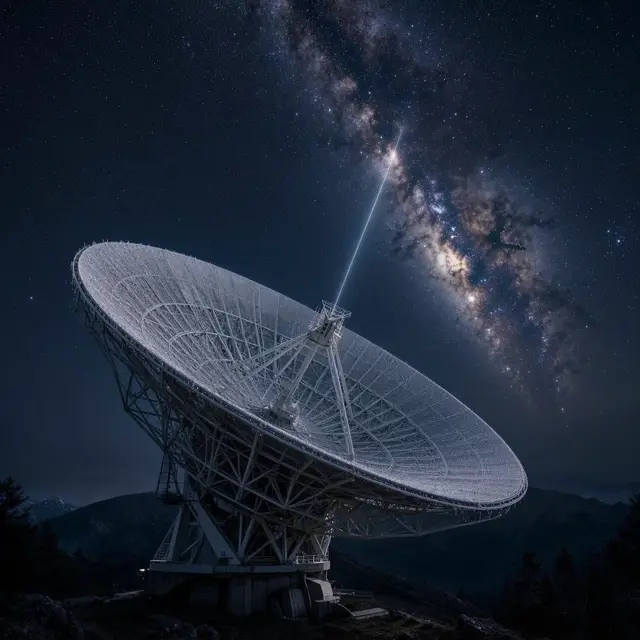
So the searches began. The SETI Institute pointed the Allen Telescope Array at the star in October 2015 and heard no radio emissions. The VERITAS observatory looked for nanosecond optical pulses; a laser search in 2018 found only Earth-based contamination. Then the decisive clue arrived: a January 2018 study led by Boyajian showed the dimming affects some wavelengths of light more than others. A solid object — a planet, a machine, anything opaque — blocks all colors equally. Fine space dust does not. The megastructure hypothesis quietly collapsed.
Solved by the Crowd, Still Not Solved
Fittingly for a star discovered by volunteers, its follow-up was crowdfunded too. In 2016, Boyajian's Kickstarter campaign raised over $100,000 to buy a year of time on the Las Cumbres Observatory's global telescope network, while more than fifty amateur astronomers kept the star under nearly continuous watch.
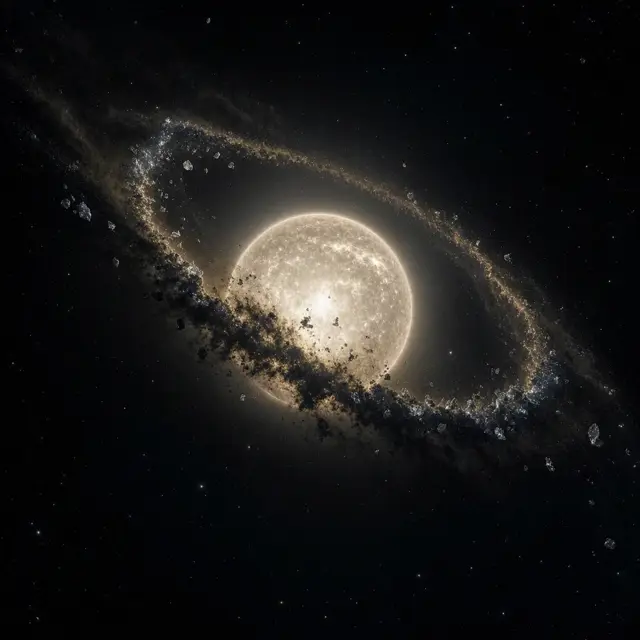
The leading natural explanations now involve dust: an uneven ring of circumstellar material, clouds of disintegrating comets, or — in a scenario formally proposed in September 2019 — the debris of an exomoon ripped from its planet and slowly grinding apart in orbit. Simulations show such orphaned moons produce matching light curves in about half of cases. Yet as of 2024, no single hypothesis explains every observed dip. The star that citizen scientists rescued from the discard pile remains one of astronomy's favorite open cases.