Almost Everything There Is
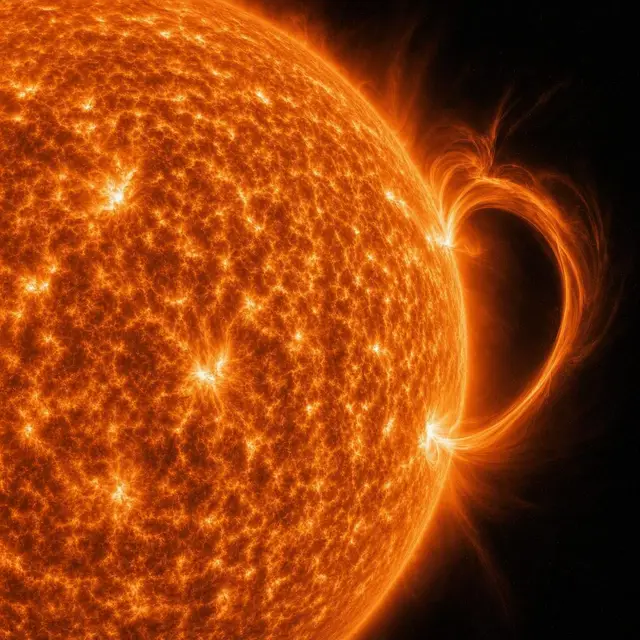
The Sun is the star at the centre of the Solar System: a massive sphere of hot plasma, heated to incandescence by nuclear fusion in its core, radiating energy from its surface mainly as visible light and infrared, with 10% at ultraviolet.
The proportions are the part people underestimate. Its diameter is about 1,391,400 km — around 109 times that of Earth. Its mass is roughly 330,000 times Earth's, and it makes up about 99.86% of the total mass of the Solar System.
Everything else — all eight planets, every moon, every asteroid and comet — divides the remaining 0.14% between them. The Solar System is, by mass, the Sun and some debris. Its photosphere is mostly hydrogen (~73%) and helium (~25%), with much smaller amounts of oxygen, carbon, neon and iron.
Four Billion Kilograms a Second
The Sun formed approximately 4.6 billion years ago from the gravitational collapse of matter within a large molecular cloud. Most of that matter gathered at the centre; the rest flattened into an orbiting disk that became the Solar System.
The central mass grew so hot and dense that it eventually ignited nuclear fusion in its core. It is now classified as a G-type main-sequence star (G2V) — an unremarkable category, which is part of what makes it useful to study.
The throughput is anything but unremarkable. Every second, the Sun's core fuses about 600 billion kilograms of hydrogen into helium, and converts four billion kilograms of matter into energy. Four billion kilograms, per second, ceasing to be matter at all. That has been running continuously for four and a half billion years.
Eight Light-Minutes Away
The Sun's mean distance from Earth is about 149.6 million kilometres — roughly 8 light-minutes. Sunlight leaving the surface takes eight minutes to arrive, so the Sun you see is always the Sun as it was eight minutes ago.
That distance was important enough to become a unit. The Earth–Sun distance defined the astronomical unit (au), now fixed at 149,597,870.7 km and used as the standard ruler for measuring the Solar System.
On the larger scale the Sun is itself in motion, orbiting the Galactic Center at a distance of 24,000 to 28,000 light-years. And it has held human attention throughout: the Sun has been an object of veneration in many cultures and a central subject of astronomical research since antiquity. It remains the main source of energy for life on Earth.
How It Ends
In about four to seven billion years, hydrogen fusion in the core will diminish to the point where the Sun is no longer in hydrostatic equilibrium — the balance between outward pressure and inward gravity that holds a star steady.
When that balance fails, the core undergoes a marked increase in density and temperature, causing the outer layers to expand. The Sun becomes a red giant.
After that phase, models suggest it will shed its outer layers and become a white dwarf: dense, cooling, no longer producing energy by fusion — but still glowing and giving off heat left over from fusion, for perhaps trillions of years. Eventually it is theorised to become a black dwarf, radiating negligible energy. The Sun spends billions of years burning, and then vastly longer than that simply cooling down.