The Only Other World With Seas
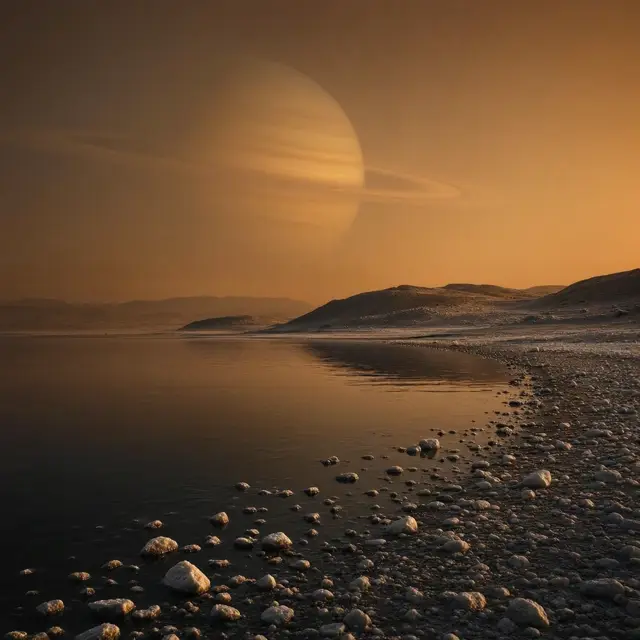
Earth is not the only place in the Solar System with lakes and seas on its surface. Titan, the largest moon of Saturn, has them too. It is the only other known world with stable bodies of liquid on the outside.
But you would not want to swim there. Titan's seas are not water. They are mostly liquid methane and ethane, chemicals that are gases on Earth. The surface is about minus 179 °C, cold enough to keep them liquid.
The biggest sea, Kraken Mare, sits near the north pole. Together with two other large seas, it makes up about 80% of Titan's liquid surface. One of them, Ligeia Mare, is around 200 metres deep.
A Moon Bigger Than a Planet
Titan is huge for a moon. It is almost 50% wider than our own Moon and is even bigger than the planet Mercury. Only Jupiter's moon Ganymede is larger.
It was discovered on 25 March 1655 by the Dutch astronomer Christiaan Huygens, using a telescope he built with his brother. He called it simply "moon of Saturn". The name Titan was given almost two centuries later, by the astronomer John Herschel in 1847.
Despite its size, Titan is light. It is only about 40% as heavy as Mercury, because Mercury is mostly iron and rock while Titan is mostly ice. From Titan's surface, Saturn would look more than ten times as large as our Moon does in Earth's sky.
Thick Orange Skies and Methane Rain
Titan is the only moon with an atmosphere thicker than Earth's. The air pressure at its surface is almost one and a half times what we feel at sea level. That air is mostly nitrogen, just like ours, with a few percent methane.
When sunlight breaks up the methane high in the sky, it makes a thick orange haze. That haze hid the surface so well that for years people thought Titan was the biggest moon of all.
Titan also has weather. Clouds form, and liquid methane falls as rain, carving rivers and filling lakes. Oddly, sunlight should have used up all the methane in about 50 million years. Something must keep refilling it, possibly icy volcanoes called cryovolcanoes.
The Farthest Landing Ever Made
For a long time, nobody could see Titan's surface. That changed when the Cassini spacecraft arrived at Saturn in 2004, carrying a small probe named Huygens.
On 14 January 2005, Huygens drifted down through the haze and landed. It is still the farthest place from Earth where any spacecraft has ever touched down. Its photos showed pale hills with dark channels running down to a flat plain, and pebbles made of water ice.
The next visitor is already planned. NASA's Dragonfly mission, set to launch in July 2028, is a large drone that will fly through Titan's thick air in the mid-2030s. It will study how far the chemistry that could lead to life has gone there.
Could Anything Live There?
Scientists have wondered whether life could exist in Titan's methane lakes, the way fish live in water on Earth. Such life would be very different from ours. It might breathe hydrogen instead of oxygen and give off methane instead of carbon dioxide.
It would also have to survive the deep freeze of minus 179 °C. Water is better than methane at dissolving things, which makes life harder to imagine there. But methane is also gentler, so it would not break down large molecules the way water can.
In 2025, NASA researchers suggested that tiny bubble-like structures called vesicles, needed to build the first cells, could form in Titan's lakes. Nobody knows yet, but that possibility keeps scientists coming back.