A Planet Rolling on Its Side
Imagine 42 years of nonstop daylight, followed by 42 years of darkness. That is life at the poles of Uranus. The planet has an axial tilt of about 82 degrees, so it spins almost on its side. As it circles the Sun once every 84 years, each pole spends about half the trip facing the Sun and half facing away.
Near the solstices, only a narrow strip around the equator gets a quick day and night, with the Sun low on the horizon. Near the equinoxes, the Sun faces the equator, and days and nights look more like those on other planets. Oddly, even though the poles get more sunlight over a full Uranian year, the equator is warmer. Nobody knows why.
Nobody is sure what tipped Uranus over either. The usual idea is that an Earth-sized protoplanet crashed into it while the Solar System was forming. Research by Jacob Kegerreis of Durham University suggests the object was even larger than Earth and struck 3 to 4 billion years ago.
The Comet That Turned Out to Be a Planet
On 13 March 1781, William Herschel was using a homemade telescope in the garden of his house in Bath, England, when he spotted something odd. He reported it as a comet. It was not. Other astronomers worked out its nearly circular path, and it was soon accepted as a new planet. By 1783, Herschel agreed.
Uranus is actually visible to the naked eye, but it is so dim and slow that ancient observers never recognized it as a planet. The earliest definite sighting came in 1690 from John Flamsteed, who saw it at least six times and listed it as a star called 34 Tauri. Pierre Charles Le Monnier saw it at least twelve times between 1750 and 1769, including four nights in a row.
Herschel's find was a big deal. It was the first planet discovered with the help of a telescope. Because Uranus is about twice as far from the Sun as Saturn, it roughly doubled the size of the known Solar System. King George III gave Herschel £200 a year, on condition that he move to Windsor so the royal family could look through his telescopes.
George's Star Loses the Naming Fight
Herschel wanted to call his planet Georgium Sidus, or George's Star, in honor of King George III. He argued that people in the future would be pleased to know it was found in the reign of King George the Third. The name was not popular outside Britain and Hanover.
Other ideas soon appeared. Some wanted to name it Herschel, after its discoverer. Others suggested Neptune, a name that later went to the next planet to be found. In 1782, the astronomer Johann Elert Bode proposed the name Uranus. The debate dragged on for a long time, and only about seven decades after the discovery did astronomers finally agree on it.
Bode's idea slowly won. In 1789, Martin Klaproth named his newly found element uranium to support it. Still, the matter was not settled until 1850, when Britain's Nautical Almanac Office, the final holdout, switched from Georgium Sidus to Uranus. That was almost 70 years after the discovery.
The Coldest Planet in the Solar System
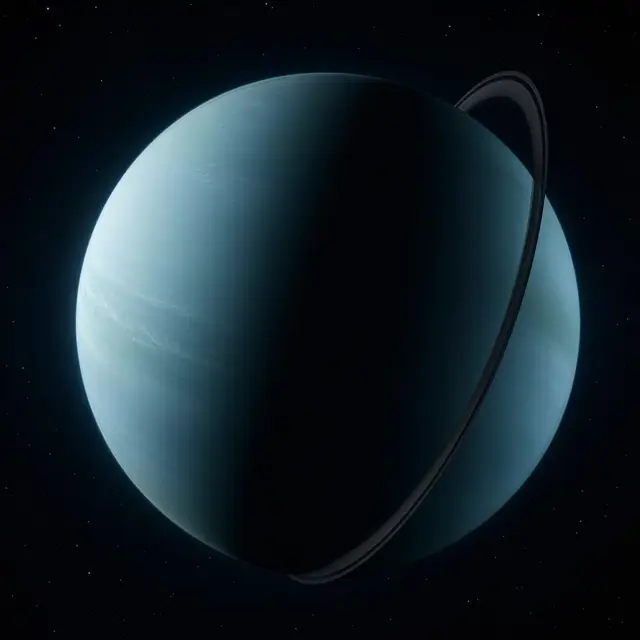
Uranus is an ice giant. Most of it is water, ammonia, and methane, not as solid ice but as a hot, dense fluid. Its mass is about 14.5 times Earth's, which makes it the lightest of the giant planets. It has no solid surface. Its gassy atmosphere slowly blends into the liquid layers below.
Methane in its atmosphere absorbs parts of the light that hits it, which gives Uranus its cyan color. The planet also holds the record for the lowest temperature of any planet in the Solar System, about minus 224 °C. Strangely, it gives off hardly any heat of its own. Neptune, its near twin in size, sends out 2.61 times as much energy as it gets from the Sun. Why Uranus is so cold inside is still not understood.
Deep inside, things may get even stranger. The huge pressure and heat could break methane apart, letting carbon form diamond crystals that fall through the planet like hailstones. Lab experiments suggest there may even be an ocean of liquid carbon at the bottom of the mantle, with solid diamond icebergs floating in it.
One Visit, Back in 1986
Only one spacecraft has ever visited Uranus. On 24 January 1986, Voyager 2 flew within 81,500 kilometres of its cloud tops. It found 10 new moons and two new rings, and gave scientists their first close look at the planet's weather and magnetosphere. That magnetic field turned out to be strange, tilted 59 degrees from the spin axis and shifted well away from the planet's center.
Uranus now has 29 known moons, named after characters from the works of William Shakespeare and Alexander Pope. Its rings were found by accident in 1977. Astronomers planned to study the planet's atmosphere during an occultation, when Uranus passed in front of a distant star. Instead, the star blinked out five times before and after Uranus covered it. The only explanation was a set of rings.
Scientists badly want to go back. A major planetary science survey made a proposed Uranus orbiter and probe a top priority for 2023 to 2032. China's Tianwen-4 mission, launching in 2029, plans to release a small probe that will fly past Uranus in March 2045.