The Twin That Went Wrong
Venus is the second planet from the Sun and close to Earth in size and mass. There the similarity stops. Its air is 96.5 percent carbon dioxide and weighs 92 times as much as ours. Standing on the surface would feel like being nearly a kilometre under the ocean.
That thick blanket traps heat, and the result is a surface temperature of about 464 degrees Celsius. Venus is hotter than Mercury even though it sits nearly twice as far from the Sun. The cause is a runaway greenhouse effect, and it may not always have been this way. Studies suggest that billions of years ago the planet could have held liquid water and an atmosphere much like the early Earth's.
As the Sun grew brighter and volcanoes resurfaced the planet, the water evaporated. Once enough greenhouse gases built up, the process ran away with itself. Carl Sagan pointed to Venus as a warning worth studying.
A Day Longer Than Its Year
Venus turns on its axis once every 243 Earth days. It goes all the way around the Sun in 224.7. That means a single spin takes longer than a full year.
It also spins the wrong way. Almost every planet turns anticlockwise, but Venus has retrograde rotation, turning clockwise instead. Stand on the surface and the Sun would come up in the west and set in the east, though you would never see it through the clouds. Because the spin runs against the orbit, a solar day on Venus works out to 116.75 Earth days, roughly half its year.
The slow backwards spin is thought to come from a tug of war. Tidal pull from the Sun tries to lock the planet in place while heating of that enormous atmosphere pushes it the other way. The day length still wobbles by up to 20 minutes. Venus has no moons at all.
Acid Clouds and Winds That Lap the Planet
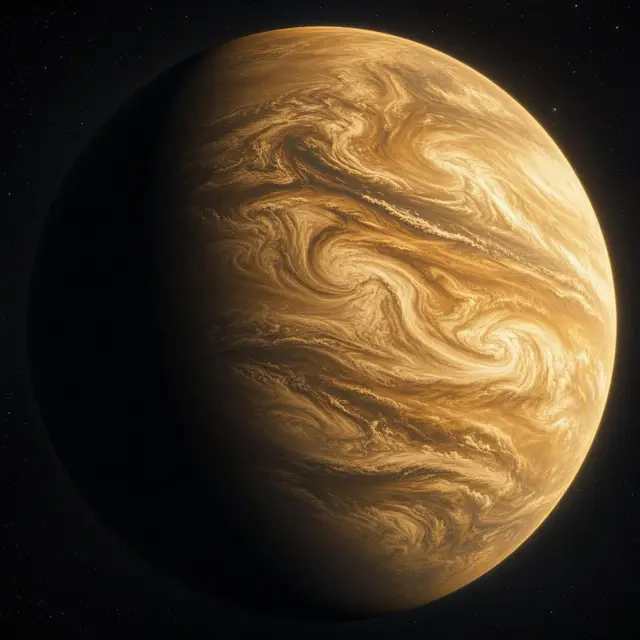
Sitting above the dense lower air is a cloud deck 45 to 70 kilometres up, made mostly of sulfuric acid. It covers the entire planet and hides the surface completely.
Those clouds are why Venus looks so bright from Earth. They reflect close to 70 percent of the sunlight that hits them, making it the brightest point of light in our sky after the Sun and Moon. The flip side is that only about a tenth of that sunlight reaches the ground, leaving the surface about as bright as an overcast day here.
The air also moves far faster than the planet does, a behaviour called super-rotation. Winds at the cloud tops blow at around 300 kilometres per hour and circle Venus in about four days, roughly 60 times faster than the planet itself turns. On the highest peaks, the Magellan spacecraft spotted a reflective coating that has been nicknamed Venus snow, though nobody is certain what it is made of.
Getting There and Surviving
Venus was the target of the first interplanetary flight attempt, the Soviet Venera 1 in 1961, which lost contact on the way. The first success was the American Mariner 2 in 1962, which gathered data on the atmosphere during a flyby.
The Soviet Venera programme then did the hard part. Venera 4 sampled the atmosphere in 1967 and found it far denser and hotter than expected. On 15 December 1970, Venera 7 became the first spacecraft to land softly on another planet and send data home. In 1975, Venera 9 and 10 returned the first pictures ever taken from the surface, in black and white.
The Magellan orbiter mapped the planet between 1990 and 1994. Its images showed a world shaped by lava rather than water. More than 85,000 volcanoes have now been identified, and the surface is a youthful 300 to 600 million years old because eruptions keep repaving it.