A Tunnel With Two Ends
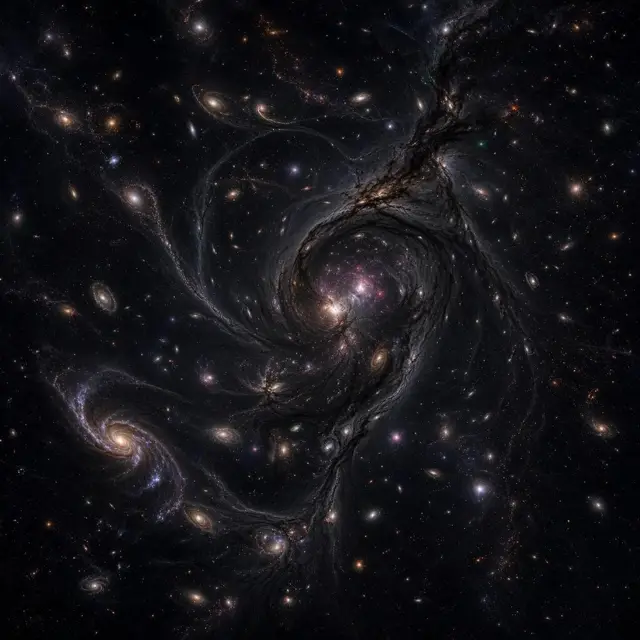
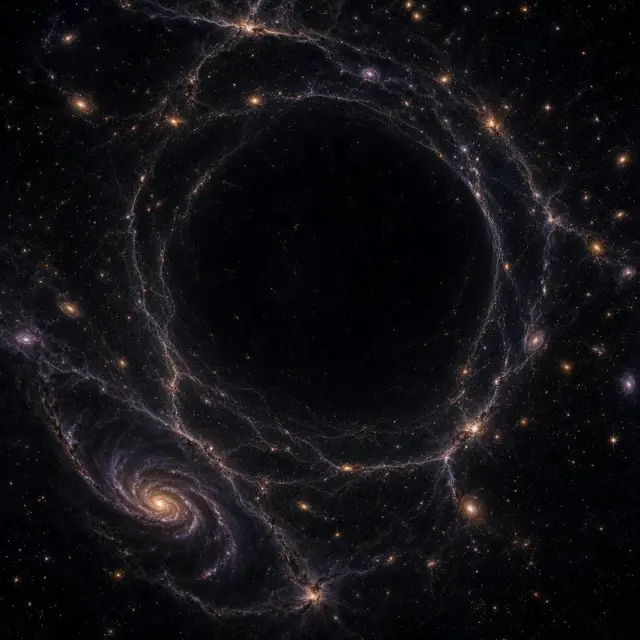
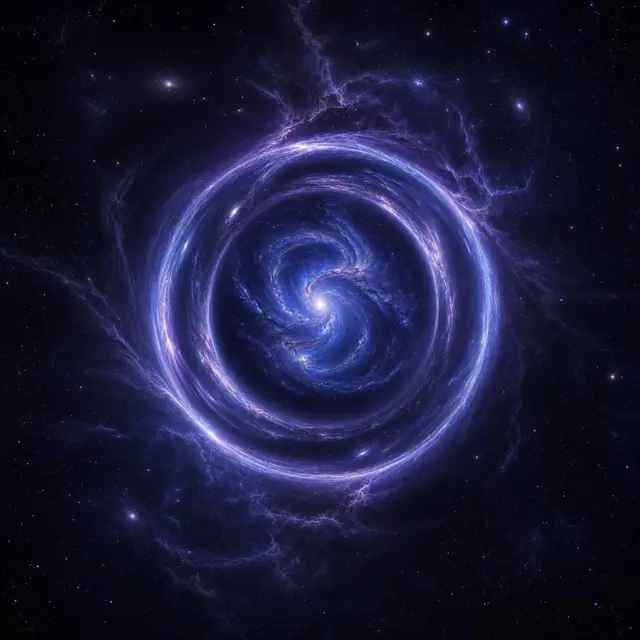
Picture a tunnel whose two ends open in different places, different times, or both. That is a wormhole, a shortcut through spacetime. Wormholes are still hypothetical. But they come from a real solution to Einstein's equations, and they fit within the theory of general relativity.
The name has a playful history. In 1928, the mathematician Hermann Weyl wrote about the idea but called the shapes "one-dimensional tubes". That same year, the astronomer Arthur Eddington used the word "worm-holes" in a popular book, but for something else entirely.
The word as we use it came from the physicist John Archibald Wheeler. In a 1957 paper with Charles Misner, he noted that mathematicians would call the shape "a handle". Physicists, he wrote, "might perhaps be excused for more vividly terming" it a "wormhole".
The Bridge Nobody Can Cross
The first wormhole in the math was found by Ludwig Flamm in 1916, a few months after Schwarzschild published his famous solution describing a black hole. Albert Einstein and Nathan Rosen found it again and published it in 1935. Today it is called the Einstein-Rosen bridge.
It hides in the math of an idealized black hole that has existed forever. Follow that math all the way and you find a black hole, a white hole that particles rise out of, and two separate outside regions, sometimes called two different "universes". Drawn at a single moment, the shape looks like a tube joining them.
Sadly for travelers, this bridge is useless. In 1962, Wheeler and Robert Fuller showed that it pinches shut so fast that not even light can make it from one side to the other. And a real black hole formed from a collapsing star would not have this bridge at all.
Holding the Throat Open
So could anyone build a wormhole you could actually travel through? Homer Ellis and K. A. Bronnikov each showed in 1973 that such crossable wormholes were possible in theory. In 1988, Kip Thorne and his student Mike Morris described one held open by a shell of exotic matter. They even suggested using it as a tool to teach general relativity.
Exotic matter carries negative energy, which sounds like fantasy. But the Casimir effect shows that the energy in certain regions of space can dip below that of empty space. Early calculations suggested a wormhole would need a huge amount of negative energy. Later ones showed it could be made as small as you like.
Nature might make wormholes too. Tiny ones could pop in and out of existence at the smallest scales, and stable ones have been suggested as candidates for dark matter. A tiny wormhole born near the Big Bang might even have been stretched to a huge size.
Beating Light Without Going Faster
Nothing can move faster than light, but that rule only applies locally. A wormhole could bend the rule without breaking it. If the tunnel is shorter than the normal route, a traveler moving slower than light could arrive before a light beam sent the long way. The funny part is that a light beam sent through the same wormhole would still beat the traveler.
Wormholes might even work as time machines. One idea is to speed one mouth up to near light speed and then bring it back. Thanks to time dilation, that end ages less and becomes "younger". Step into the younger end, and you come out of the older end in the past, as seen from outside.
There is a catch. You could never go back to a time before the machine was made. And in 1993, Matt Visser argued that the wormhole would collapse, or its mouths would push apart, before it could break cause and effect.
Parallel Worlds and Science Fiction
Time travel creates paradoxes, and one proposed way out involves other universes. In 1991, David Deutsch showed that quantum theory stays consistent even in spacetimes with a closed timelike curve, a loop in time. In one view, a particle returning from the future does not land back in its own universe but in a parallel universe. A wormhole time machine with a tiny time jump would then be a bridge between universes existing side by side.
Science fiction loves wormholes for a simple reason. They let characters cross between stars, galaxies and even universes within a human lifetime. Some stories use them for time travel too.
Stories also borrow the warp portal, a shortcut that folds space through a hidden fourth dimension. Think of a flat sheet. To bring two distant points together, you must bend it through a third dimension. In the same way, our space would need a fourth one to fold.